
An article written by Rebecca Rapparini
Communication with a gender lens: why is it needed?
When we hear about someone who migrates, we often think of a man. When images of overcrowded boats sinking in the sea are presented in the media, the individuals depicted tend to be primarily men. Women, when represented, are often the exception, appearing as victims or passive figures. To counteract this stigmatising and invisibilising narrative, it is crucial to develop a communicative approach capable of including the voices of migrant women, moving beyond paternalistic and colonial logics. The application of an inclusive and feminist approach to communication appears evermore urgent for journalists and social organisations working with people on the move.
The feminisation of migration: back to the 60s
Part of the problem lies in the general lack of awareness of a phenomenon that has been emerging globally for some time: the feminisation of migration. In 1960, women already made up nearly 47% of all international migrants, a figure that increased by just two percentage points over the next four decades (UN-INSTRAW, 2009). While some regions have experienced a clear feminisation of migration flows, the most significant shift in recent decades has been not the number of women migrating but the nature of their migration.
Increasingly, women migrate independently in search of work rather than as dependents accompanying or joining their husbands abroad. This has been largely driven by changes in the global job market. Wealthy countries with aging populations but weak social care policies face a growing demand for low-cost female care-workers (UN-INSTRAW, 2009).
Although women have always migrated, for a long time studies focused only on men, viewing them as “primary” migrants, ignoring the key presence of women (“secondary” migrants). It is precisely the persistence of this model that reinforces the notion of women as passive and dependent followers, whose role, if any, is less important (Palumbo, 2011).
Dominant representations and essentialism
The dominant portrayals of female migrants fall into one (or multiple) archetypes:
as a victim, and therefore vulnerable;
as a sex worker, therefore socially stigmatised and worthy of “shame”;
or as a mother, therefore to be protected and saved.
The representations described above align with specific political agendas, instrumentalising the experiences of migrant women to fit reductive dominant discourses about migration. Failing to talk about female migrants—rendering them invisible—or reducing them into categories is not coincidental but rather a deliberate choice that reflects the global patriarchal paradigm that simplifies and marginalizes migrant women’s experiences.
The reduction of individuals to single characteristics is a mechanism known as essentialism, whereby the complexities of human experience and identity are disregarded and individuals are defined by one trait (Grosz, 1990). In migration, this often means defining individuals solely by their status as migrants, overlooking the diversity within migrant communities. This oversimplification fuels stereotypes, reinforces discrimination, and supports unequal power structures.
Migrant women face this issue even more strongly due to overlapping layers of discrimination. They are often portrayed through gendered stereotypes, primarily as passive figures tied to family roles like mothers or wives. Such portrayals ignore the independence and resilience of many migrant women, distorting their stories and denying their agency in the migration experience.
A significant consequence of essentialism is the process of victimisation. Migrant women are frequently portrayed as disempowered, dependent, vulnerable, and in constant need of rescue. This dynamic is further compounded by moralisation, where women—especially those in the sex industry—are simultaneously viewed as victims and objects of societal shame.
This one-dimensional portrayal obscures the nuanced agency and resilience that often characterise women’s migration experiences. Although violence and exploitation are real challenges faced by many migrant women, framing them solely as victims erases other aspects of their experiences, including their resilience in confronting these adversities.
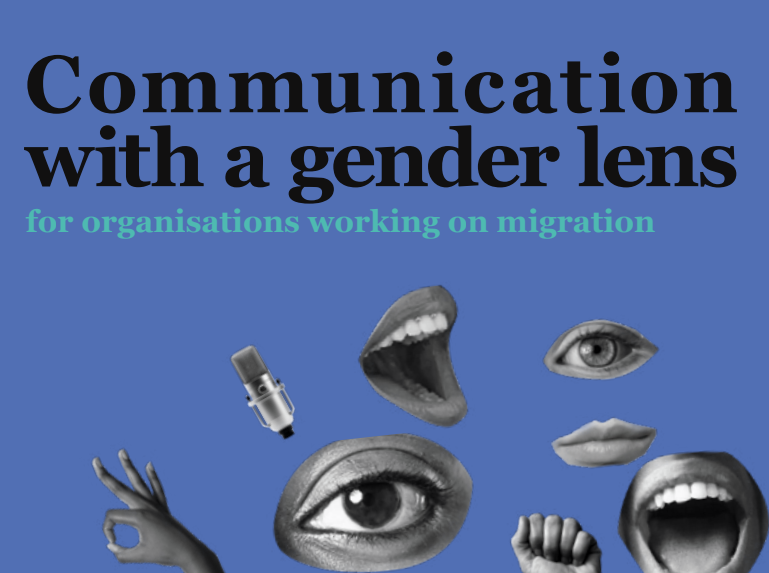
It is from these considerations, and mainly gaps, that motivated the creation of the guide ‘Communication with a gender lens for organisations working on migration’, with a view to leaving essentialism and victimisation behind.
A comprehensive, inclusive and feminist guide: Stories4All methodology
This guide was developed as the product of the collaboration between Open Cultural Center and Yemayá Revista, under the guise of the Erasmus+ project Stories4All.
The main goal of the project was to develop best practices in participatory, gender-sensitive, and inclusive communication about migration, both within the participating organisations and more broadly. The shortcomings and distorted representations discussed above highlight the compelling need for a methodology to explore inclusive practices and narratives of migrant women.
Faced with these questions, the most suitable approach was considered to be the feminist methodology. Chosen for its focus on gender inequalities, it emphasises the creation of transformative discourses, the recognition of intersectionality and the multiple oppressions faced by women on the move, and, finally, the practice of reflexivity, which requires researchers to critically assess their own role and position. It also promotes the participation and inclusion of the communities involved in the research.
Final considerations: feminism without borders
‘Communication with a gender lens’ thus constitutes an example of good practice for organisations working on migration, as it stems from the shared need of NGOs workers to develop inclusive communication methods. The methodology includes several key recommendations:
- individuals should be considered as creators, not subjects;
- vulnerability should be recognised, but not made central;
- create a safe, fair and non-judgmental atmosphere;
- underline the free choice to participate or not; use translation and cultural mediation if necessary;
- be empathetic and show respect for the decision;
- avoid pressuring individuals; offer alternatives to participation and recognise the reasons for refusal.
A fundamental pillar is undoubtedly the importance of considering cultural differences without impeding cooperation. This concept resonates with Chandra Mohanty’s feminism without borders (2003), a framework that does not advocate for a border-less feminism per se, but to a more expansive and inclusive feminism that remains attentive to borders while also learning to transcend them.
What we should embrace, also from a narrative point of view, is a vision of solidarity, which focuses not only on the intersections of race, class, gender, nation, and sexuality in different communities of women but on mutuality and complication (Mohanty, 2003). Only by embracing a vision that recognises differences as much as commonalities will it be possible to lay the foundations for a change of perspective that includes and strengthens the voices ‘at the margins’. In line with this reflection, we must begin to challenge what is meant by ‘the centre’.
For practical advice on how to implement these good practices on communicating about migrant women, you can access the full guide here.



Stories4All is an Erasmus+ project funded by the European Union. It brings together 3 partners in 2 EU countries: Open Cultural Center Spain, Open Cultural Center Greece and Yemayá Revista. You can find out more about all of our European projects by visiting our Europe page.