
An article written by Nicola Vasini
On November 23, 2024, around 170,000 people demonstrated in the center of Barcelona to demand an immediate reduction in rent prices and the right to decent housing for all. The demonstrations then spread to other Spanish cities, such as Madrid, Seville and Valencia. One of the main demands of civil society was to guarantee fair and non-discriminatory access to housing, a problem that affects not only foreign residents, but also Spanish citizens belonging to different ethnic groups and religious minorities.
Discrimination in the housing market
“I went to visit a house and as soon as the owner saw me, she asked me: where are you from?” says Asma Nawaz, 30. “When I told her I was from Pakistan, her face changed and she quickly ended the visit. I felt very angry.”
Asma spent a whole year in Barcelona looking for a stable and safe home. “I left an overcrowded house where I didn’t feel safe as a woman and it affected my health a lot,” she continues. “Then I lived two months in one place and three in another. I never imagined I would find myself in a situation like this.”
Maodo Kande, 22, a warehouse worker, says he has also suffered discrimination when looking for accommodation in Barcelona. “Finding accommodation here is crazy,” he says. “They tell you that the room is free, but when you arrive and they see the colour of your skin, suddenly they tell you it’s already taken. How is that possible?”
Alarming data in Spain
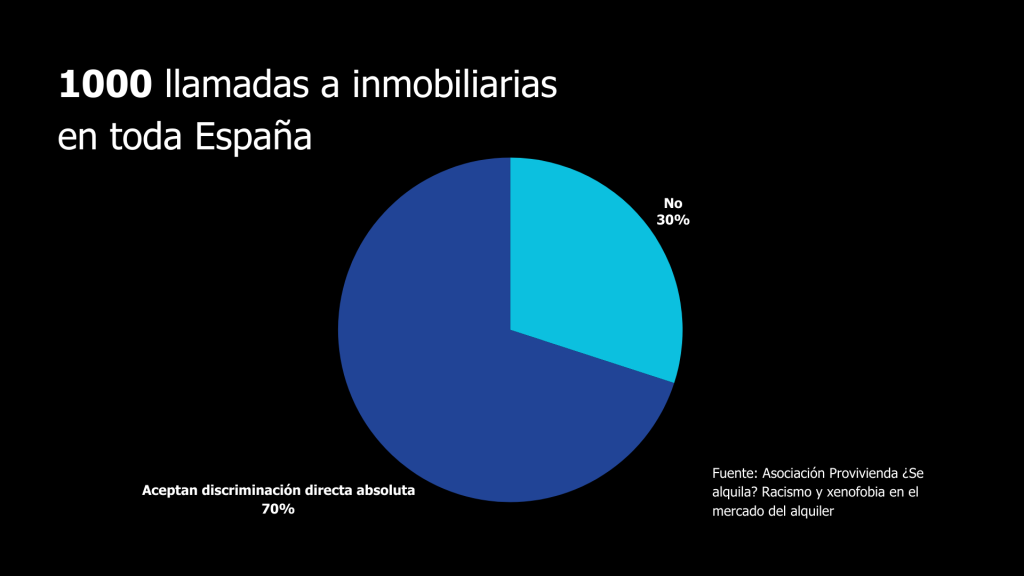
The study “¿Se alquila? Racismo y xenofobia en el mercado del alquiler”, published in 2020 by the Asociación Provivienda, reveals a worrying reality: out of 1,000 calls to different real estate agencies throughout Spain, more than 70% accept direct discrimination, i.e. respecting the will of property owners not to rent to foreigners. Moreover, 80% of the remaining 30%, while they do not accept direct discrimination, are willing to accept different conditions for foreign tenants than for Spanish tenants, such as asking for additional documentation, increasing the rental price or offering lower quality housing.
“We are facing a situation in which only a very small percentage of the real estate agencies contacted do not practice any type of discrimination.”
Says Juande Gómez Montoya, of Asociación Provivienda. “Agencies play a central role in the rental market in Spain: today, almost all rentals go through them.”
It is not only someone’s country of origin that determines discrimination, but also prejudice based on an individual’s name. A 2020 Barcelona City Council study “La llave puede ser el nombre”, revealed that people with local Spanish or Catalan names are 18.8% more likely to get a response from real estate portals and, therefore, to access housing than those with names of Arabic origin. “Here the socio-economic profile of the person applying for housing is not being valued at all, nor the nationality, but only the name,” explains Montoya. “When in reality, Mohamed can be just as Spanish as Juan, and Juan can be just as foreign as Mohamed.”
Precarious housing conditions
Difficulties and the urgency to find housing push many people to accept extreme conditions, ending up in unsafe situations. “I had very bad experiences and had a very bad time,” says Asma Nawaz, recalling the year she spent looking for a stable home.
“These people don’t have many options and then what happens, they end up in sub-standard housing, on the street or sub-letting housing at abusive prices,” adds David Jacue Bretón, project coordinator for Refugees Welcome Spain. The association helps refugees and displaced people find decent housing by putting them in contact with the local population. Refugees Welcome supported both Asma and Maodo in their difficult search for a room in Barcelona.
The association also collected some conversations with landlords contacted to rent rooms on Facebook or Idealista: “My husband does not want Moroccans”, “Where is the person from?”. These are just some of the answers to the request for information; these phrases reflect a widespread practice, despite the fact that residential discrimination is prohibited by law.

“When reporting, it is important to collect evidence, such as emails and WhatsApp messages,” says Juande Gómez Montoya. “Complaints can be filed at the police station, the duty court or the consumer office, since denial of service is a violation of the law.” However, the legal route is not easy. The long procedures discourage many people and it is also a painful process,” adds Montoya.
Fighting residential discrimination
In addition to individual citizen complaints, the role of institutions is crucial to counteract residential discrimination. “It is essential for the public administration to create specific departments that inform victims of discrimination, train staff in this area and deal with the application of sanctions,” explains Montoya. “Without an effective system of sanctions, the feeling of impunity ends up fueling further residential discrimination.”
Since 2022, Spain has an important legislative tool in the fight against residential discrimination: the ” Ley Integral para la Igualdad de Trato y la No Discriminación” which explicitly addresses the issue of access to housing.
However, without an independent authority that can enforce the law, assist victims, conduct investigations and impose sanctions, it is difficult to ensure its effectiveness. That is why it is crucial that the government approves the creation of such a body as soon as possible,” adds Montoya.
Internationally, there are already good practices in this area. In the United States, for example, the Fair Housing Testing Program, sponsored by the Department of Housing and Urban Development (HUD) and civil rights organizations, employs trained testers to check whether landlords, real estate agents and financial institutions are complying with fair housing laws. In the event of a violation, the results of the investigations can be used to initiate formal proceedings and, in some cases, result in sanctions or legal action.
Finally, given that real estate agencies and agents represent a crucial access point to the housing market, “it is important to reform the training requirements for these professionals by introducing specific modules on non-discrimination and equal treatment.” Concludes Juande Gómez Montoya, of the Provivienda.