The Caravan of Exile, a Counter-Narrative Tool Against Polarization: On How Face-to-Face Dialogue in Public Spaces Can Rehumanize the Conversation on Migration
We live in a world where the overwhelming surplus of information and hyperconnectivity doesn’t necessarily equate with well-informed individuals or fact-based, constructive exchanges. We sit comfortably within the confines of our echo chambers1, consuming unverified content at the flicker of a thumb curated on our screens, unable to process the influx of information, and lacking the tools to sift fact from myth. Our world views become more and more rigid, reinforcing our biases and therefore leading to increased polarization.
Among the most polarizing subjects manipulated in this environment is μετανάστευση2. Across Europe, it has become a recurring, often hackneyed talking point, yet remains a powerful winning card for far-right movements3. By stoking fears and peddling conspiracy theories that portray migrant people as threats, from myths about “stealing benefits” to the so-called Great Replacement, these narratives continue to reinforce prejudices and fuel division, across different demographics. Younger4, middle aged and older users 5alike are differently impacted by the exposure to such extremist rhetoric online, depending on the platform and their respective engagement patterns.
What would it actually take to break this cycle? Could moving away from digital spaces to meet people in real life and talk face-to-face rehumanize the conversation on migration?
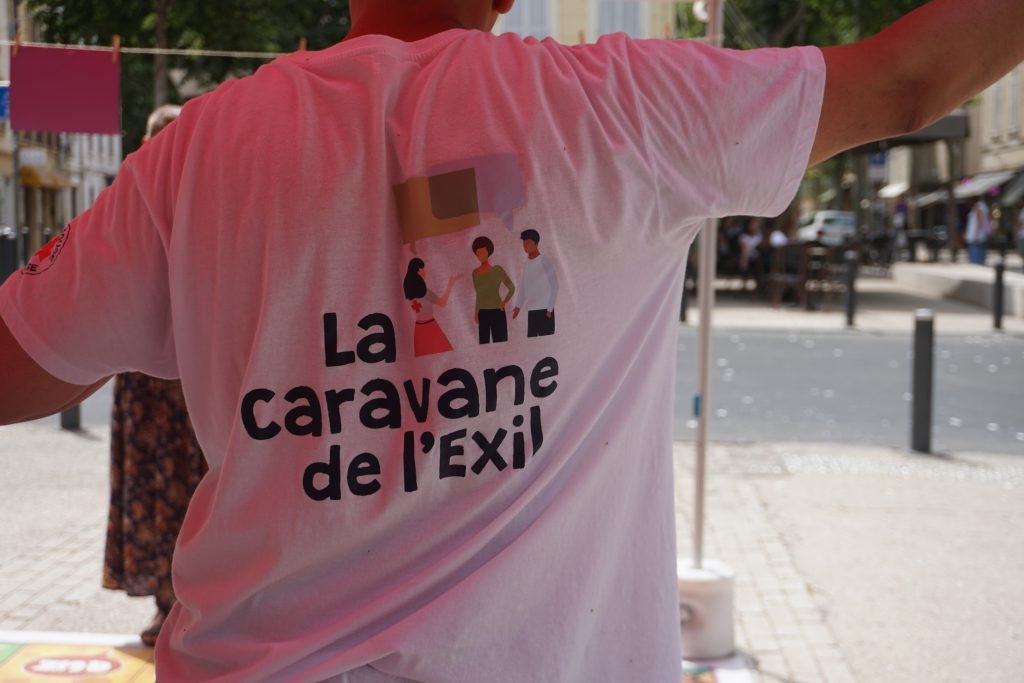
That’s a challenge the Caravan of Exile set out to tackle. This initiative, created by τοΓαλλικός Ερυθρός Σταυρός in the years after the pandemic, is a mobile awareness-raising campaign which travels across different parts of France during the summer holiday period and is designed to engage members of the public in conversations about migration.
What is the Caravan of Exile ?
The Caravan of Exile’s mission is to debunk myths and stereotypes on migration and open a space for dialogue with members of the public who would otherwise not be given the opportunity to have such conversations. Quite an unorthodox approach, but one that yields its fruits. This summer, the Caravan embarked on its fifth edition, completing five rotations in various regions across France and reaching 3,757 people through awareness-raising activities, achieving 130 hours of engagement, 19 event dates, and the mobilization of over 100 volunteers.
Our Journey Through la Provence :
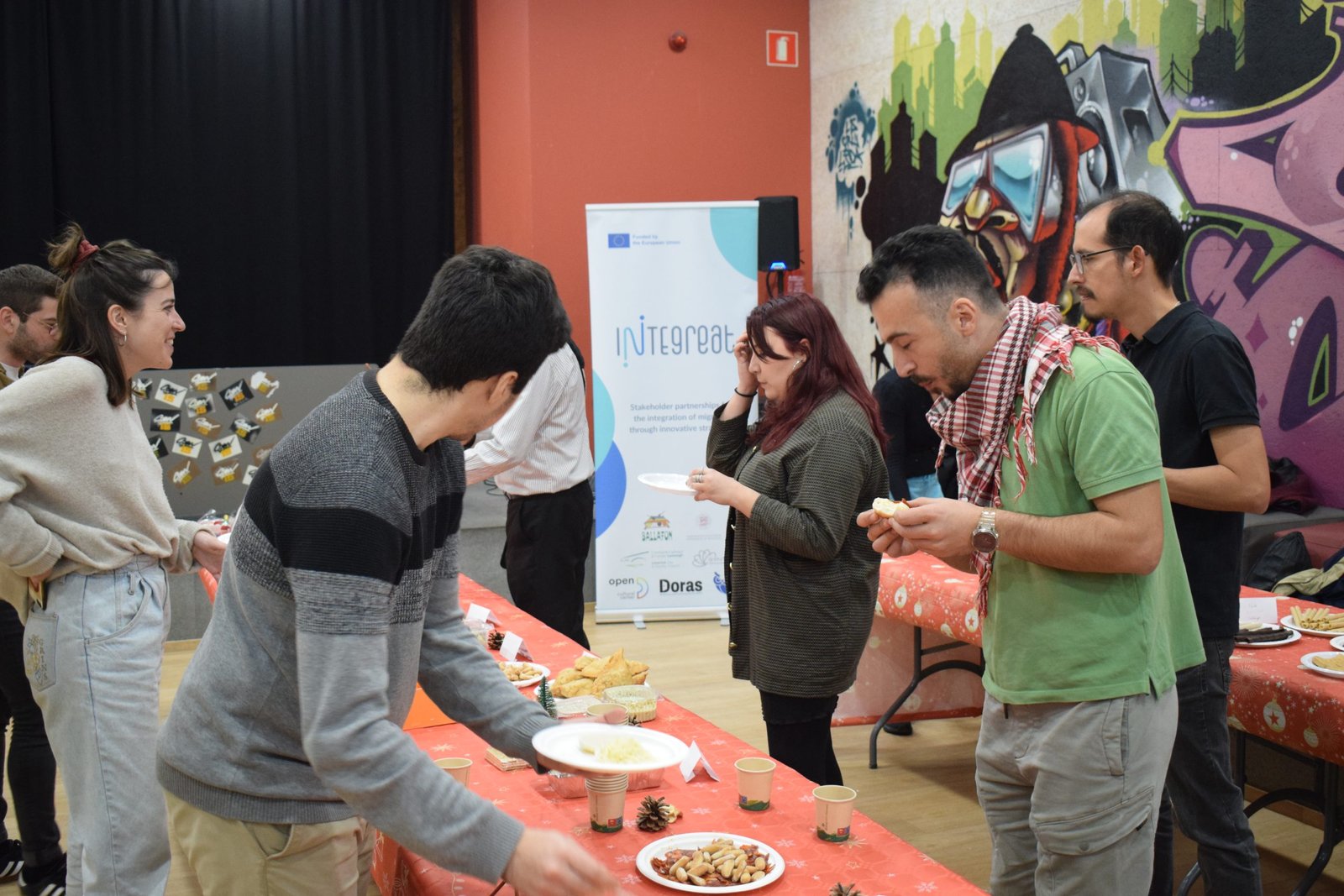
The Caravan of Exile is reaching a new milestone: the project will embark on its first trans-border journey to Spain in 2026, in collaboration with Ανοιχτό Πολιτιστικό Κέντρο (OCC). To prepare for this next step, three OCC team members joined forces with the French Red Cross this year, participating in the second rotation of the Caravane, alongside 3 Red Cross volunteers. We travelled to four French cities : Arles, Apt, Salon de Provence, and Aix en Provence, and although only separated by a few kilometers, each city had its own touch, specificity and demographics. In the span of 4 days, we were transported into different realities. In total, these activities reached 688 individuals, averaging 172 per day, with the support of 13 local volunteers.
A number of factors, such as timing, our location in each city, and the current events happening, all shaped our experience. We not only got to interact with locals, but also tourists and inhabitants from other parts of France, as these cities attracted different kinds of visitors depending on the events of the time. For example, our visit to Arles, one of the largest cities on our rotation, coincided with the International Photography Festival, attracting art aficionados from all around the world. Apt, on the other hand, being the smallest city that we visited, brought us into contact more with small local business-owners. In Salon-de-Provence, as the Carvane was parked in front of the Town Hall, we got to witness from our very own tents, three civil marriages. Our last stop in Aix en provence was the calmest, with families and tourists rambling slowly through the town, enjoying a hot summer Sunday before the city geared up for its 14th of July activities.
The activities of the Caravan :
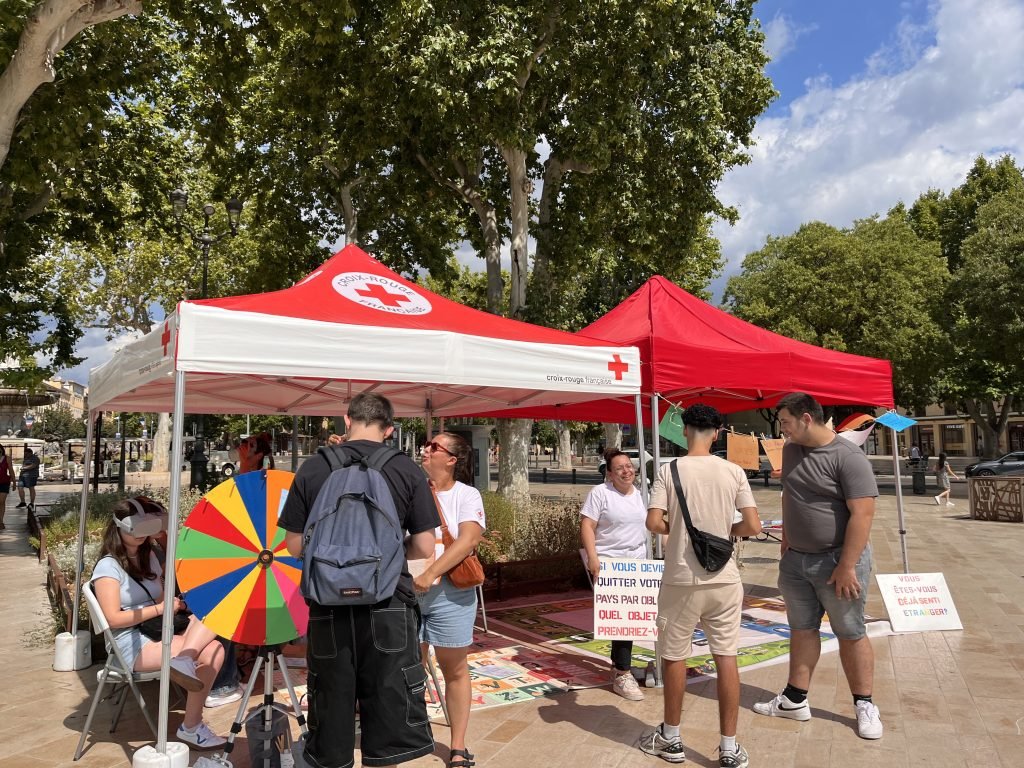
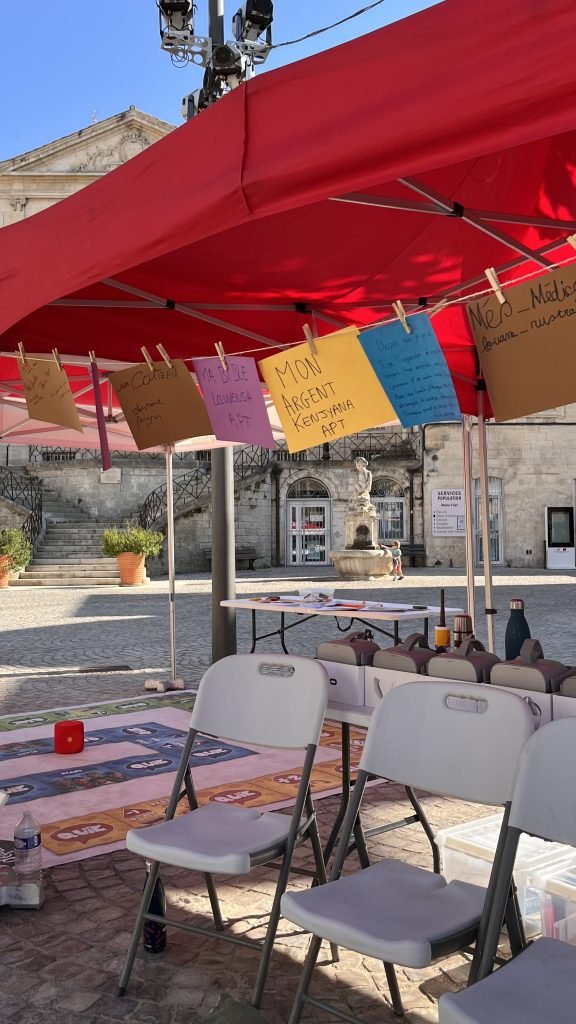
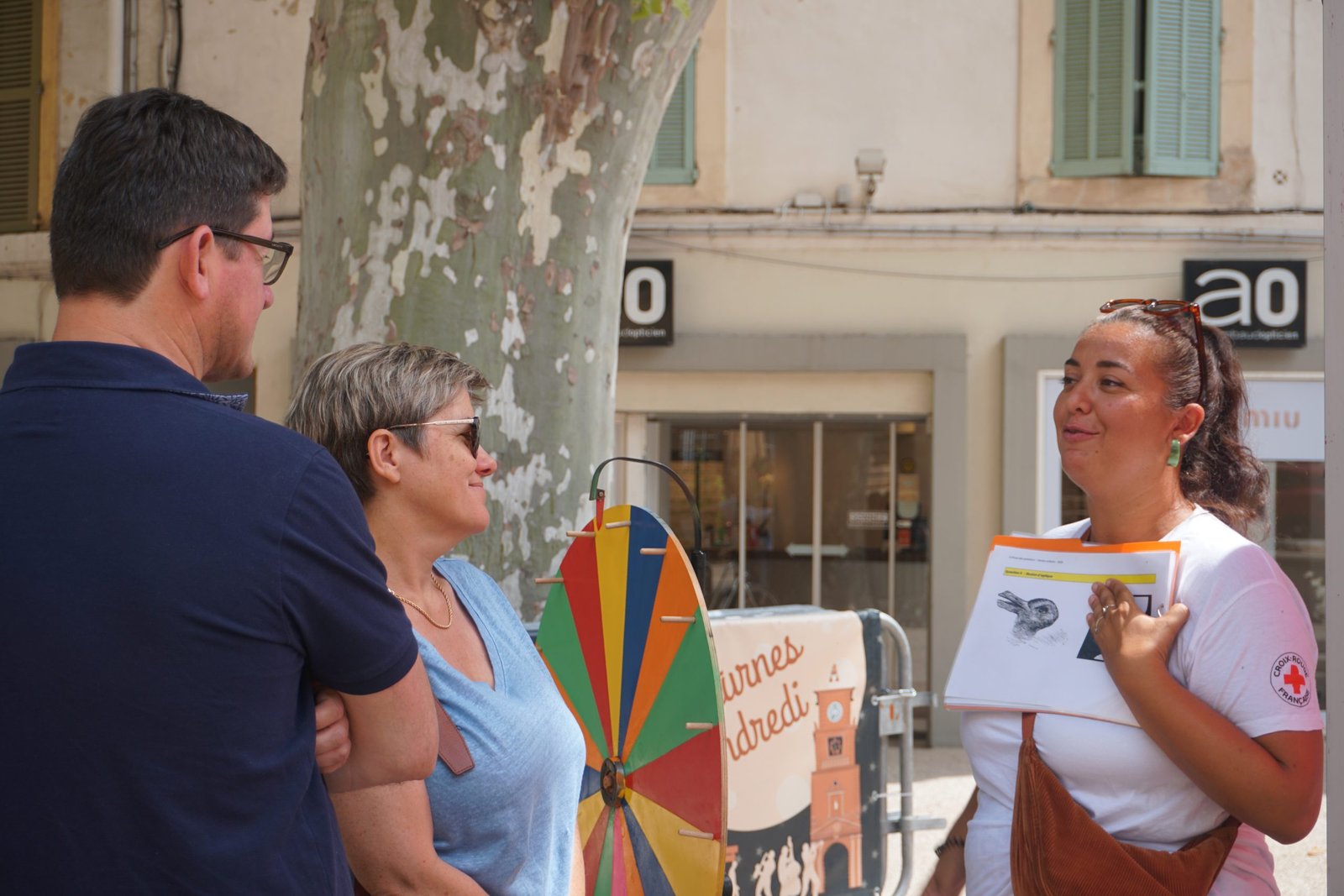
Every morning the Caravaners would arrive in a new city, unload the truck, install the tents and different activity stands to start the day, with the aim of reaching as many people as possible. The Caravan offers a wide range of interactive activities adjusted to children and adults :
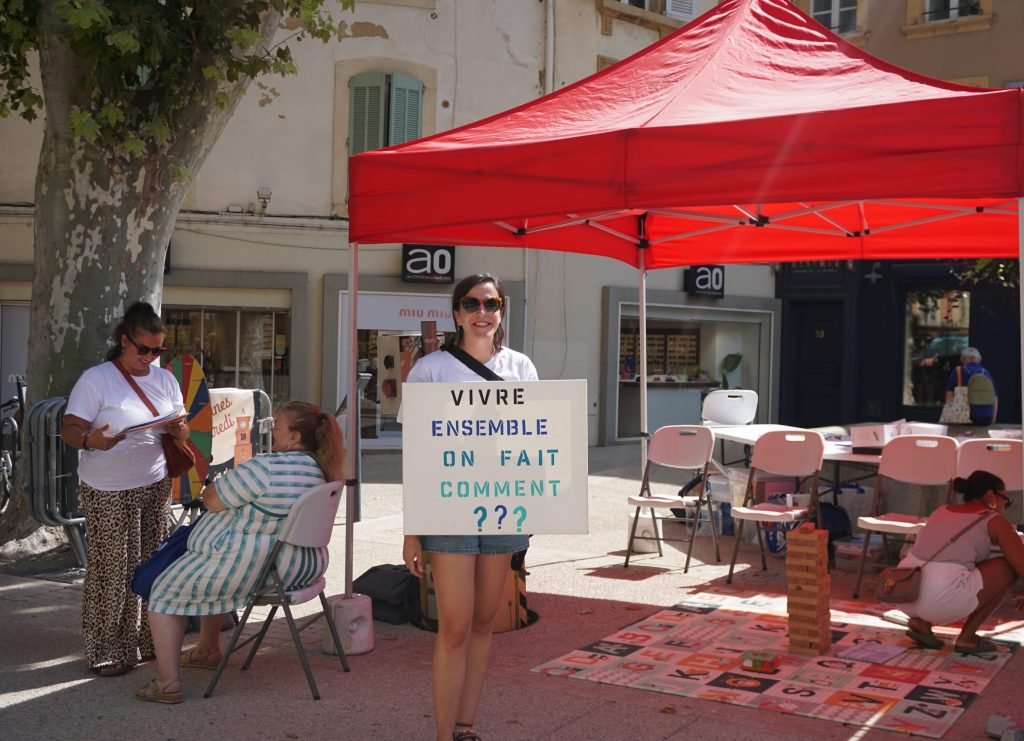
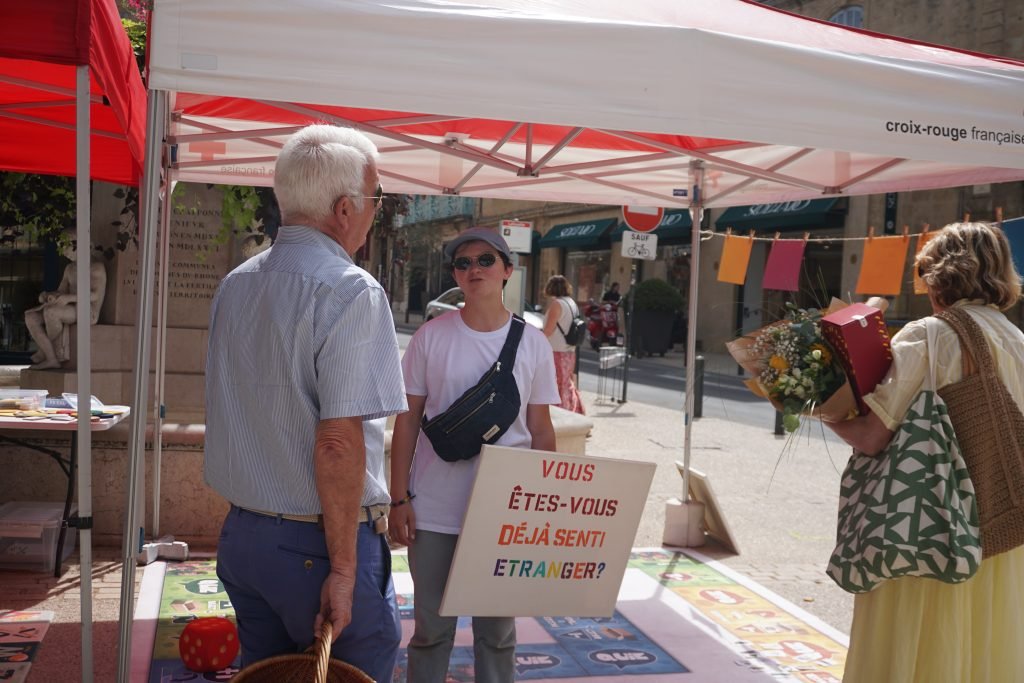
One of the activities that struck me as the most challenging was the Spokesperson activity. Armed with hand-written placards and big smiles, the Caravaners roam the streets and spark conversations with strangers, acting as dialogue facilitators. The objective behind this activity is to feel the pulse of the public opinion on topics related to migration. The placards carry different questions designed to provoke conversation and reflection, such as : “ If you were forced to leave your home, what would be the one object that you would take with you?” ,” Have you ever felt like a foreigner? ”, “How can we live together?”, translated as “Vivre ensemble, on fait comment?”
In fact, the concept of Vivre ensemble goes beyond the literal translation of “living together”, as it encapsulates the idea of social cohesion, and the “harmonious coexistence between individuals or between communities”, according to Larousse6. Nonetheless, it’s important to flag the complexity of this concept. Seen as a cornerstone of the political French values, and used in different legal contexts (e.i as a basis for the antiseparatism law7 in France in 2021, and cited in the jurisdiction of the European Court of Human Rights on several occasions), it remains ambiguous, defined case by case8, when social cohesion is deemed threatened. Which begs the question: Is this concept a social ideal, unattainable by definition, or worse, a compromise between cultural diversity and “European Universalism”? but that’s a whole other conversation for another article.
The answers from the people that we interacted with varied : from generic and pragmatic to philosophical. The tone of the replies also differed, from people answering lightly and almost in passing, to others taking time and sharing very analytical and well-informed replies.
As Red Cross volunteers, the Caravaners should don the gloves of neutral, non-judgmental dialogue mediators, letting the public lead the conversation but remaining attentive to redirect the conversation, ask questions and show curiosity, even when faced with inappropriate or shocking comments.
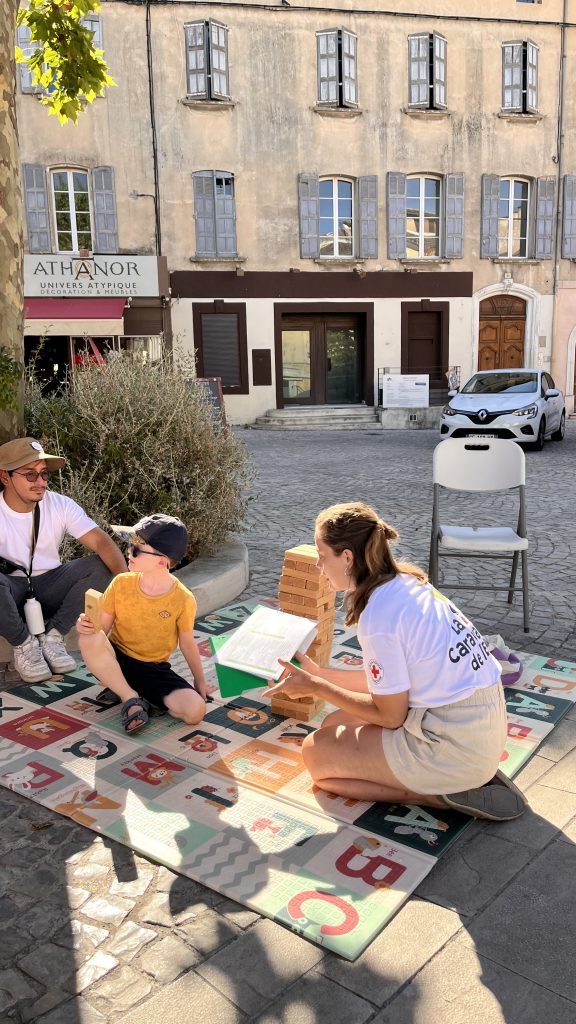
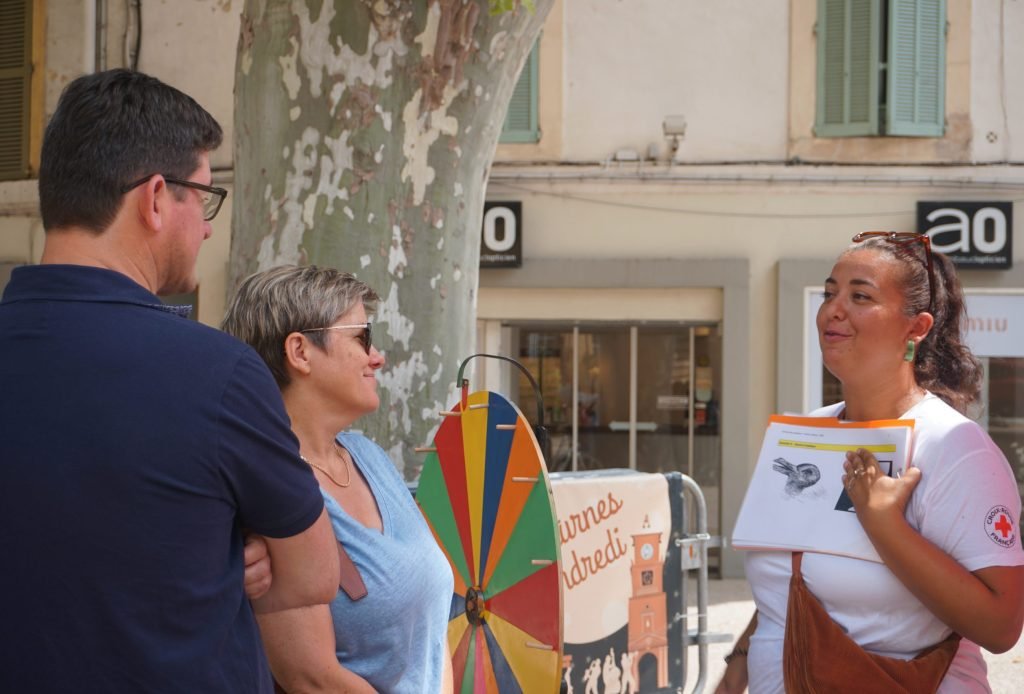
Wheel of fortune and Jenga Games : both of these games are quizzes dedicated to debunking myths and providing facts around the theme of migration. The quizzes cover various topics ranging from International Humanitarian Law and migration law, to geography, interculturality and history. Some of the questions were centered around the common misconceptions about newcomers living in France, and were designed to lead the participants to think beyond clichés and engage with facts. Questions included : “What is the monthly amount of the allowance received by a single asylum seeker hosted in France?”, and “True or False: A person seeking asylum has the right to work in France”
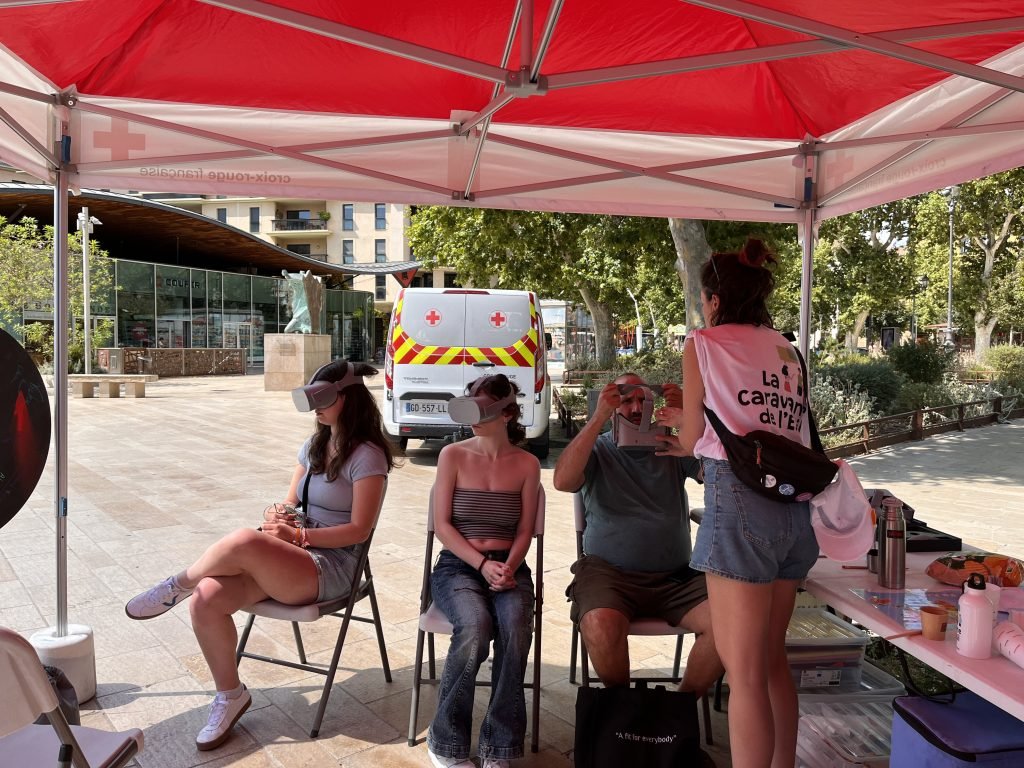
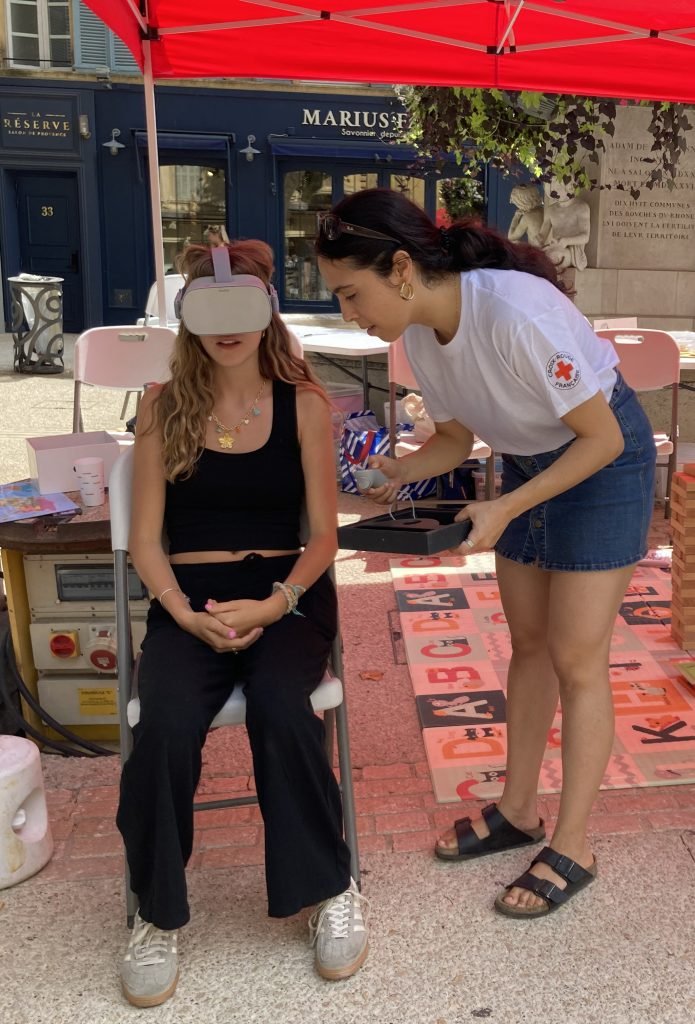
Virtual Reality headsets : participants could choose between two short movies : “Sense of Home”, portraying the daily life of a refugee camp on the Syrian-Lebanese border, and “Sense of War”, depicting life in a war zone in Donbass region in Ukraine (filmed in 2015). Both adopt a documentary-like approach, providing an immersive 360 degrees experience with testimonies from civilians sharing their daily living conditions in exile and war. Debriefing with the participants after the activity is paramount, namely asking them if virtual reality helps them get a better understanding of the humanitarian context and the living conditions in these camps, and if they have ever personally met a refugee person before.
Interactive Board Game : Designed primarily for children, the game presents players with several stories of displaced children forced to leave their homes. Players select a character and are guided through the different stages of that child’s journey and the obstacles and decisions they face along the way. The stories present different scenarios of children originating from different social and political contexts.
The caravan, a space for creating social bonds :
What would make people stop and engage in a conversation about migration on a random summer day? It turns out that months of preparation, thoroughly planned itineraries, municipal permissions, coordination with volunteers across locations, webinars and training would not do the trick on their own. A Caravaner also needs a mix of social skills and situational awareness to be able to navigate the complexities of real life interactions with strangers. Charlotte Grimont, Migration Dynamics Officer at the French Red Cross, noted:
We encountered more people closed off to dialogue compared to previous years, but the experience was wonderful and full of optimism. The Caravan shows that dialogue is possible when we create a safe, non-judgmental space.
Indeed, after the numerous encounters that I made in the Caravan, coupled with the feedback from fellow volunteers and organizers, I came to the conclusion that there is a real need for face-to-face awareness-raising in the public space. Joana Purves, Communications Officer at OCC, also underlined the importance of these “spontaneous dialogue spaces” that the Caravan created. The lack of rigid formal structures, combined with reflective questions and the interactive activities entice dialogue and makes it accessible to the average passerby.
Beyond raising awareness, I also couldn’t help but notice the social dimension of the Caravan. It creates a space for human connection : some passers-by stopped by the Caravan to feel heard, to share, or simply to feel less alone. One visitor, recently arrived from Cameroon, told a colleague that it was his first meaningful interaction in days. People experiencing homelessness also confided their daily challenges with us. A lady of a certain age, spent around an hour sitting under the tent to express her support for our project and her indignation towards the discriminations migrant and refugee individuals face. Some passers-by would approach us directly with interest and curiosity, others would need to be convinced first, some showed suspicion and avoidance, but in every case, a social link was established.
Facing Challenges:
While the Caravan was undoubtedly a place for fruitful exchanges, it was also at times hard to reach common ground or have constructive conversations when the counterpart limited themselves to stereotypes and hollow generalities. Some of the recurrent misconceptions that were voiced were particularly around what is meant by “integration’’ and “assimilation”, often perceived as responsibilities falling exclusively on migrant people. In addition, during their interactions with passers-by, several Caravaners mention instances of pervasive and overt racism, misinformation and a lack of general knowledge on the subject. Clara Florensa, European Project Manager at OCC observed :
there were still some very stark and openly expressed racist and fascist views, things I wouldn’t have imagined people saying so freely in the street just a few years ago.”
At the same time, many volunteers also reported hopeful signs: open-mindedness among young people and the commitment of parents who engaged alongside their children in the activities of the Caravan.
Yasmine, another Caravan volunteer, reflects : "Many people struggle to put themselves in others’ shoes. Empathy, curiosity, and the ability to see different perspectives are fully at stake.”
This reflection echoed an experience of mine during the Spokesperson activity: a woman initially showed indifference toward migrant and asylum-seeking individuals at the beginning of the conversation, but after being asked the question ‘Have you ever felt like a foreigner?’, she revealed her vulnerability by sharing her own feeling of exclusion in social settings, particularly as a woman of a certain age. Even though her reality was very different from that of migrant people, the question prompted her to think how isolation and exclusion could feel like and therefore sparked empathy where none seemed possible at the beginning. As Clara Florensa puts it, these spaces are “really important to foster understanding, open-mindedness, and empathy toward each person’s situation.”
What’s next for the Caravan?
Building on lessons and reflections from this summer’s experience, the OCC and the French Red Cross teams will prepare for the Caravan’s first trans-border journey in summer 2026. This collaboration includes translating and adapting existing materials into Spanish, English and Catalan, co-creating a new activity with a broader European focus, and a pilot event on the 18th December for International Migrants Day.
The Caravan was a rich human experience, and a much-needed tool that helped us meet people on the ground and feel the pulse on topics related to migration and asylum through spontaneous exchanges within the public space. What stays with me is also the encounters with the volunteers and the organizers of the Caravan, their generosity, unwavering support, and the daily debriefs at the dinner table at the end of our long days.
CARAVANE is a project co-funded by the European Union through Erasmus+ and implemented by Open Cultural Center and the French Red Cross.
Bail, C. A., Guay, B., Maloney, E., & Rivers, D. (2023). Short-term exposure to filter-bubble recommendation systems increases political polarization.Proceedings of the National Academy of Sciences, 120(26), e2023301118. https://doi.org/10.1073/pnas.2023301118 ︎
European Commission. (2025, May 29). Digital deception: The role of social media in radicalising middle-aged and older users. European Commission Newsroom. https://ec.europa.eu/newsroom/home/items/885752/en︎
Open Cultural Center Spain and Greece are proud to participate in Refugee Week 2025 by hosting a ser…
Χρησιμοποιούμε δικά μας cookies και cookies τρίτων για να σας προσφέρουμε καλύτερη εμπειρία στον ιστότοπό μας, σύμφωνα με τις προτιμήσεις και τις συνήθειες περιήγησής σας (για παράδειγμα, σελίδες που επισκεφτήκατε). Μπορείτε να λάβετε περισσότερες πληροφορίες στο Πολιτική Cookie. Μπορείτε να αποδεχτείτε όλα τα δικά μας cookies και τα cookies τρίτων που χρησιμοποιούμε πατώντας το κουμπί "Αποδοχή" ή να ρυθμίσετε ή να απορρίψετε τη χρήση τους πατώντας το κουμπί "Ρύθμιση cookies". Αποδοχή όλων των cookiesΡύθμιση των cookies
Διαχείριση ρυθμίσεων cookie
Πληροφορίες & διαμόρφωση cookie
Αυτός ο ιστότοπος χρησιμοποιεί cookies που αποθηκεύουν και ανακτούν πληροφορίες κατά την περιήγησή σας. Σε γενικές γραμμές, αυτές οι τεχνολογίες μπορούν να εξυπηρετήσουν πολύ διαφορετικούς σκοπούς, όπως, για παράδειγμα, την αναγνώρισή σας ως χρήστη, τη λήψη πληροφοριών σχετικά με τις συνήθειες περιήγησής σας ή την προσαρμογή του τρόπου εμφάνισης του περιεχομένου. Κάντε κλικ στις παρακάτω επικεφαλίδες για κάθε τύπο cookie για να αλλάξετε τις προεπιλεγμένες ρυθμίσεις.
Μπορείτε να διαβάσετε την πλήρη Πολιτική Cookie μας εδώ.
Τα απαραίτητα cookies είναι απολύτως απαραίτητα για τη σωστή λειτουργία του ιστότοπου. Αυτά τα cookies εξασφαλίζουν βασικές λειτουργίες και χαρακτηριστικά ασφαλείας του ιστότοπου, ανώνυμα.
Cookie
Διάρκεια
Περιγραφή
__cfduid
1 μήνας
Το cookie χρησιμοποιείται από υπηρεσίες cdn όπως το CloudFare για την αναγνώριση μεμονωμένων πελατών πίσω από μια κοινή διεύθυνση IP και την εφαρμογή ρυθμίσεων ασφαλείας ανά πελάτη. Δεν αντιστοιχεί σε κανένα αναγνωριστικό χρήστη στην εφαρμογή ιστού και δεν αποθηκεύει καμία πληροφορία που μπορεί να ταυτοποιηθεί προσωπικά.
X-Mapping-fjhppofk
Αυτό το cookie χρησιμοποιείται για σκοπούς εξισορρόπησης φορτίου. Το cookie δεν αποθηκεύει δεδομένα που μπορούν να αναγνωριστούν προσωπικά.
Τα cookies διαφημίσεων χρησιμοποιούνται για να παρέχουν στους επισκέπτες σχετικές διαφημίσεις και καμπάνιες μάρκετινγκ. Αυτά τα cookies παρακολουθούν τους επισκέπτες σε όλους τους ιστότοπους και συλλέγουν πληροφορίες για την παροχή εξατομικευμένων διαφημίσεων.
Cookie
Διάρκεια
Περιγραφή
IDE
1 έτος 24 ημέρες
Χρησιμοποιείται από την Google DoubleClick και αποθηκεύει πληροφορίες σχετικά με τον τρόπο με τον οποίο ο χρήστης χρησιμοποιεί τον ιστότοπο και οποιαδήποτε άλλη διαφήμιση πριν επισκεφθεί τον ιστότοπο. Αυτό χρησιμοποιείται για να παρουσιάζονται στους χρήστες διαφημίσεις που τους αφορούν σύμφωνα με το προφίλ του χρήστη.
test_cookie
15 λεπτά
Αυτό το cookie ορίζεται από την doubleclick.net. Ο σκοπός του cookie είναι να διαπιστωθεί εάν το πρόγραμμα περιήγησης του χρήστη υποστηρίζει τα cookies.
VISITOR_INFO1_LIVE
5 μήνες 27 ημέρες
Αυτό το cookie ορίζεται από το Youtube. Χρησιμοποιείται για την παρακολούθηση των πληροφοριών των ενσωματωμένων βίντεο του YouTube σε έναν ιστότοπο.
Τα αναλυτικά cookies χρησιμοποιούνται για την κατανόηση του τρόπου με τον οποίο οι επισκέπτες αλληλεπιδρούν με τον ιστότοπο. Αυτά τα cookies βοηθούν στην παροχή πληροφοριών σχετικά με τις μετρήσεις του αριθμού των επισκεπτών, του ποσοστού αναπήδησης, της πηγής επισκεψιμότητας κ.λπ.
Cookie
Διάρκεια
Περιγραφή
_ga
2 χρόνια
Αυτό το cookie εγκαθίσταται από το Google Analytics. Το cookie χρησιμοποιείται για τον υπολογισμό των δεδομένων επισκεπτών, συνεδριών, καμπανιών και για την παρακολούθηση της χρήσης του ιστότοπου για την αναφορά ανάλυσης του ιστότοπου. Τα cookies αποθηκεύουν τις πληροφορίες ανώνυμα και αναθέτουν έναν τυχαία παραγόμενο αριθμό για την ταυτοποίηση των μοναδικών επισκεπτών.
_gid
1 ημέρα
Αυτό το cookie εγκαθίσταται από το Google Analytics. Το cookie χρησιμοποιείται για την αποθήκευση πληροφοριών σχετικά με τον τρόπο με τον οποίο οι επισκέπτες χρησιμοποιούν έναν ιστότοπο και βοηθά στη δημιουργία μιας αναλυτικής έκθεσης σχετικά με την πορεία του ιστότοπου. Τα δεδομένα που συλλέγονται περιλαμβάνουν τον αριθμό των επισκεπτών, την πηγή από την οποία προήλθαν και τις σελίδες που επισκέφθηκαν σε ανώνυμη μορφή.
Τα λειτουργικά cookies βοηθούν στην εκτέλεση ορισμένων λειτουργιών, όπως η κοινοποίηση του περιεχομένου του ιστότοπου σε πλατφόρμες κοινωνικής δικτύωσης, η συλλογή σχολίων και άλλες λειτουργίες τρίτων.
Cookie
Διάρκεια
Περιγραφή
__cf_bm
30 λεπτά
Αυτό το cookie ορίζεται από την CloudFare. Το cookie χρησιμοποιείται για την υποστήριξη του Cloudfare Bot Management.
Τα cookies επιδόσεων χρησιμοποιούνται για την κατανόηση και την ανάλυση των βασικών δεικτών επιδόσεων του ιστότοπου, τα οποία βοηθούν στην παροχή καλύτερης εμπειρίας χρήστη για τους επισκέπτες.
Cookie
Διάρκεια
Περιγραφή
_gat
1 λεπτό
Αυτό το cookie εγκαθίσταται από το Google Universal Analytics για να περιορίσει το ρυθμό αιτήσεων ώστε να περιορίσει τη συλλογή δεδομένων σε ιστότοπους υψηλής επισκεψιμότητας.
YSC
σύνοδος
Αυτά τα cookies τίθενται από το Youtube και χρησιμοποιούνται για την παρακολούθηση των προβολών των ενσωματωμένων βίντεο.