
An article written by Lydia Lowe
Ceuta and Melilla are small Spanish enclaves above the north of Morocco with the unique position as Europe’s only land borders with Africa. This situates them within one of the key migration routes from Sub-Saharan and north Africa to Europe. Known as the border guards of “Fortress Europe”, movements across their borders are closely policed and heavily securitised with 10-meter-high fences and advanced surveillance systems1. These dangerous journeys by land or sea is just the beginning; those who survive it, particularly the children who arrive alone, are met with extreme hostility and marginalisation.
The exact number of unaccompanied minors who cross the Moroccan border into the enclaves is unclear as children are often misclassified as adults or do not have their identity verified2. Nonetheless, the figures are substantial. Authorities in Melilla reported that around 193 migrant children were being housed in minors’ centres in May 2025, while in Ceuta, where 3% of unaccompanied migrant minors in Spain are received, the official number of children being hosted by the end of July was quoted to be 5283. These enclaves have the highest rates of children in state “care” among Spain’s autonomous communities4.
State protection and operations
The main facilities operating for minors are Centros de Menores (minors’ centres), semi-open facilities which intend are supposed to offer social assistance and essential services for those aged between 12-18 years old. However, neglect, inhumane conditions and overcrowding drive many children to live on the streets without protection or access to basic services. Once living on the streets, these young people have no support network and face prejudice from the local people and authorities who label them as criminals. This situation points to a state “care” system completely void of care.
Since taking on child protection responsibilities in 1997, Melilla established a network of three minors’ centres which have consistently been overwhelmed, with the number of migrant children under care rising from about 70 in 1999, while poor conditions and mistreatment are pervasive5. La Purísima, the most infamous of Melilla’s centres for minors, is an isolated former military barracks surrounded by neglected areas with adult settlements. Its staff often lack the resources to provide
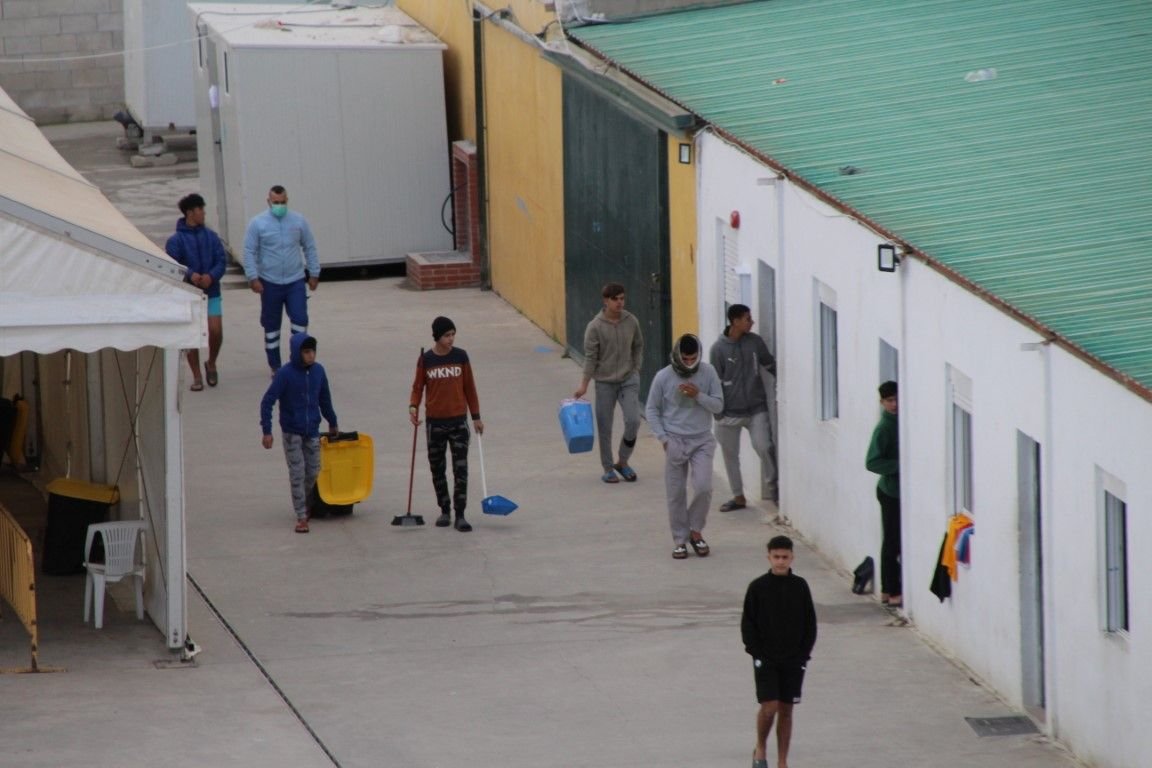
Centros de Menores, Ceuta.
proper care and there have been serious delays in processing legal documentation to regularise the minors’ residency status. In one notable incident at La Purísima, state forces entered the centre and used violence against several children, claiming it was necessary to control a riot. Solidary Wheels, an NGO which reports human rights violations carried out along the Spanish/Moroccan border, has expressed concern that rather than addressing such situations through educational and protective approaches appropriate for children, authorities employ methods of repression and abuse.6
Ceuta’s child protection system has faced similar criticisms, including inadequate reception conditions, reports of violence, no opportunities for the children to receive an education, and repeated failures to provide documentation for the regularisation of their residency status. Only one centre for minors, La Esperanza, operated in Ceuta until the recent opening of the Piniers centre. Others were also opened during the COVID-19 pandemic including the Polideportivo habilitado de Santa Amelia– where around 200 children were staying following its adaptation from a sports centre, and Las Naves de Tarajal-three former warehouses previously used for storing goods in which more than 400 minors were housed in 2021. Though intended as temporary centres with plans to relocate the children to more suitable accommodation, due to political opposition around moving minors to other Spanish regions, children remained indefinitely in these dire conditions. Following temporary closures, they have been reopened without the requirements needed to make them permanent structures, with issues such as a lack of ventilation and windows risking the children’s wellbeing7.
Challenges faced by migrant minors
A non-profit organisation based in Ceuta, No Name Kitchen, works to collect information about the conditions migrant children are experiencing in the minors’ centres and support those living on the streets. In an interview, they explained the realities of the criminalisation and punishment of unaccompanied migrant children in the enclave. For example, they explained that the Centro de Punta Blanca, a “centro reformatorio”, functions as a prison, where children who are housed in minors’ centres are arbitrarily moved and detained for perceived “challenging” behaviour. Following a trial, in which the children have no access to legal support or a translator, they can be charged with staying there for up to six months and some are regularly subjected to physical punishment. This highlights that no changes have been made since the Ombudsman’s visit in 2022, which confirmed that there were failures in the admission protocols, adaptation of care to specific needs, and the use of force and restrictive measures8.
“And when someone does a very bad thing, or what they think is a very bad thing, they put them in Punta Blanca.” “They are just fed up with the kids, and they just put them in Punta Blanca
“The kids, when they go out from the centre, they are different. They are very submissive. Their personality changes.”
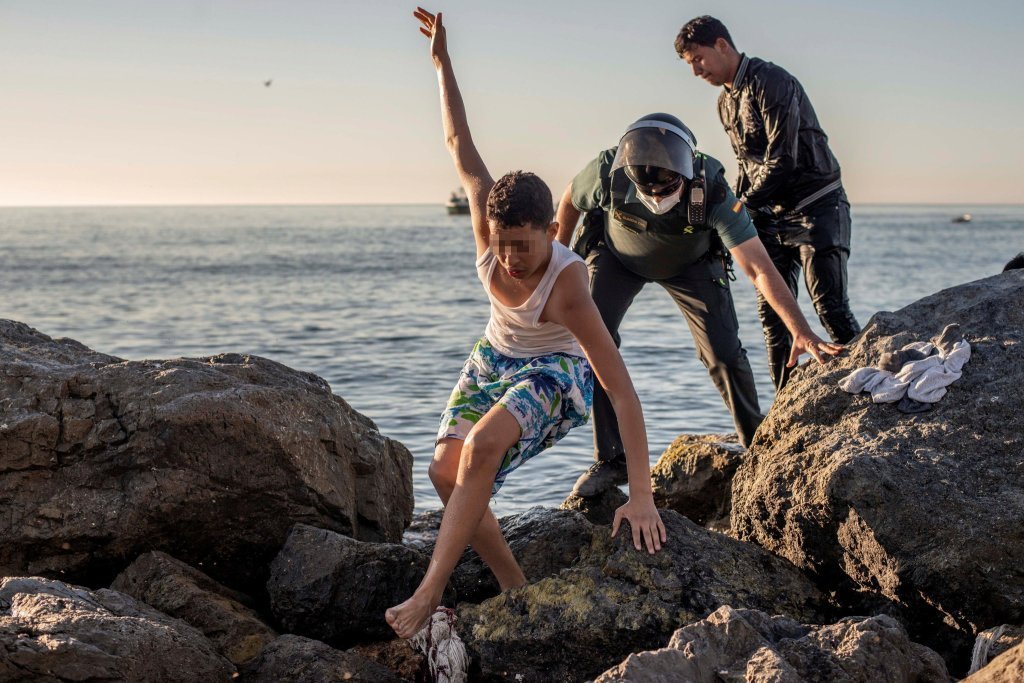
Driven by the dire circumstances within the minors’ centres, a significant number of unaccompanied children end up living on the streets of Ceuta and Melilla. Basic necessities are not met; they often sleep under makeshift shelters, resorting to asking for money from locals for food or to send money back to their families. Life on the streets is also marked by violence and drug use, as No Name Kitchen explained, “There are a lot of fights, a lot of problems. But of course, they are in the street. It’s not the best scenario for a kid.”
Beyond these immediate threats, there is systemic negligence. In Melilla, minors who are not back at the centre by midnight are often simply classified as “voluntarily absent,” with official search protocols rarely activated9. Conversely, in Ceuta police officers regularly attempt to return migrant children living on the streets to the centres, but the minors flee to avoid having to relive the abuse and neglect they faced there. According to No Name Kitchen, these authority figures, like the public, frequently perceive the children living on the streets as criminals, assuming that only the “bad” ones end up in such precarious situations.
“If there is a kid taking drugs, it’s because something is not working“.
A further critical issue arises when minors turn 18 and are no longer under state protection, becoming ex-tutelados. While they are entitled to a residence card to regularise their situation and seek employment, this process is frequently delayed for months, during which they are completely abandoned by the state. Though there is one non-profit organisation in Ceuta which provides support to ex-tutelados, San Antonio, it only has the capacity to host 10 people at a time. This is a struggle that young migrants in both autonomous cities face, and in some cases 18-year-olds are never issued a residency permit at all.
Civil society actors operating in Ceuta and Melilla play an essential role in exposing the practices of children’s temporary resettlement centres and supporting unaccompanied minors living on the streets. No Name Kitchen is one of the only sources of support for migrant minors in Ceuta, who are abandoned by the state and overlooked by other larger organisations. They provide essential services and basic necessities to the children on the streets, including medical aid and clothing and, with the collaboration of Luna Blanca, they distribute food. Activities like picnics, football matches and beach trips play an equally important role in No Name Kitchen’s work as they create spaces where the children feel safe and able to trust the volunteers.
What can be done?
Through gathering reports of the children’s experiences, No Name Kitchen is able to make recommendations to the Area de Menores. Ceuta’s government department for minors,or example, after passing on feedback they had received about a centre without windows and hot water, improvements were implemented. Importantly, testimonies from the children can be used to investigate rights violations and produce advocacy reports to drive political action and raise public awareness. For No Name Kitchen, this is key to shifting the prejudices against unaccompanied migrant children in Ceuta and Melilla,
“I think the most important thing is to change the discourse about them.”
“There is a lot of misconception for sure. And a lot of racism.”
Widespread racism and a perception of the minors as a problem in the enclaves is exacerbated by politicians and the media, which contributes to an unwillingness to make positive changes in a care system which requires urgent reforms. The critical work of local organisations like No Name Kitchen can only continue with sustained financial support and a shift in how the children crossing these borders are perceived.
All children have a right to protection. We must challenge the negative perceptions that fuel the neglect of young people on the move in Ceuta and Melilla and push for structural change to improve oversight and entry procedures of minors’ centres. By changing the discourse and demanding action, we can build a system that truly cares for migrant children, offering them a chance for a better future.
This article was published as part of CREATE, a project funded by the European Union. ΔΗΜΙΟΥΡΓΩ is a project aiming to support unaccompanied minors by offering tailored language classes to hel their social and labour inclusion.


Lydia is a long-term ESC volunteer at Open Cultural Center. Our volunteer programme is funded by the European Union through the European Solidarity Corps.

- Godenau, D., López-Sala, A. (2016). Migration and Borders: Empirical Patterns and Theoretical Implications in the Case of Spain. In: Domínguez-Mujica, J. (eds) Global Change and Human Mobility. Advances in Geographical and Environmental Sciences. Springer, Singapore. https://doi.org/10.1007/978-981-10-0050-8_3
︎ - Caminando Fronteras. Victims of the Necrofrontier 2018-2022: For Memory and Justice. Human Rights Observatory of Caminando Fronteras, December 2022, caminandofronteras.org/wp-content/uploads/2023/01/Report-Victims-of-the-necrofrontier-2018-2022.-For-memory-and-justice-Right-to-life-ENG.pdf.
︎ - Melilla acoge casi siete veces más menores migrantes de los que le corresponden por población.” El Faro de Melilla, 28 May 2025, https://elfarodemelilla.es/melilla-acoge-casi-siete-veces-mas-menores-migrantes-de-los-que-le-corresponden-por-poblacion/; Jones, Sam. “Migrants swim from Morocco to Ceuta as officials say enclave ‘overwhelmed’.” The Guardian, 12 Aug. 2025, https://www.theguardian.com/global-development/2025/aug/12/migrants-swim-from-morocco-to-ceuta-as-officials-say-enclave-overwhelmed.
︎ - Irídia and Novact. Human Rights Violations on Spain’s Southern Border 2021-2022: Institutional Racism, Borders and Migration Policy. May 2023, iridia.cat/wp-content/uploads/2023/06/HR-violations-South-Border-2021-22.pdf.
︎ - Gazzotti, Lorena. Unaccompanied and separated children: patterns of child migration are changing at the southern Spanish border. Statewatch, 13 February 2023, www.statewatch.org/analyses/2023/unaccompanied-and-separated-children-patterns-of-child-migration-are-changing-at-the-southern-spanish-border/.
︎ - Solidary Wheels. Marhaba, violencia policial como producto de la violencia sistémica en Melilla. 2020-2022. April 2023, https://www.solidarywheels.org/informes. ︎
- Maakum Ceuta, No Name Kitchen, and Elín. Informe sobre las vulneraciones de derechos de los niños, niñas, adolescentes y jóvenes migrantes en Ceuta. June 2021, observatoriodelainfancia.es/oia/esp/descargar.aspx?id=7521&tipo=documento; Sempere, Antonio. “Ceuta vuelve a acoger menores migrantes en las naves industriales del Tarajal.” El Mundo, 9 Aug. 2024, https://www.elmundo.es/espana/2024/08/09/66b64ad8e4d4d8fb738b456e.html.
︎ - Irídia and Novact. Human Rights Violations on Spain’s Southern Border 2021-2022: Institutional Racism, Borders and Migration Policy. May 2023, iridia.cat/wp-content/uploads/2023/06/HR-violations-South-Border-2021-22.pdf
︎ - Solidary Wheels. Street or risky: that is the question. 12 Sept. 2024, https://en.solidarywheels.org/post/street-or-risky-that-is-the-question.
︎