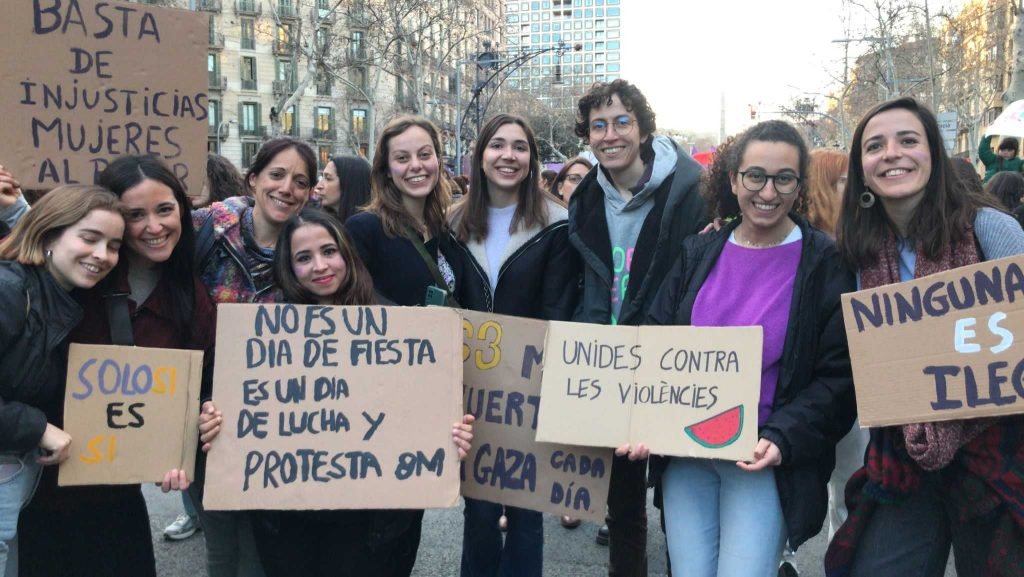
A joint statement by the workers of Open Cultural Center & Refugees Welcome Spain
This International Women’s Rights Day, the workers of Open Cultural Center and Refugees Welcome Spain raise our voices in unison with the 8M movement to emphasise the value of care and to denounce the exploitation of carers all over the world.
Care sustains life!
On this day, we commemorate the struggle fought by women and non-binary people, standing in solidarity to protest the multitudes of patriarchal violence produced by the global modern-colonial gender system.
We uphold intersectional feminism as our core framework. Feminism cannot ignore the intersecting oppressions of race, class, migration, and sexuality.
We embrace a movement that is anti-racist, anti-capitalist, and inclusive of all genders.
This year, we highlight the critical importance of care, which is feminized and devalued under patriarchal capitalism. Care for ourselves, one another, and the planet is essential for fostering justice and equity.
The care sector is absolutely vital; it includes raising children, maintaining households, caring for the sick, and building community. Yet, neoliberal economies prioritize capital over care. The result is that carers are undervalued, rendered invisible, and reduced to precarious work that lacks labor protections. Both unpaid domestic laborers and paid carers are inadequately recognized and compensated for their crucial contributions.
Across Europe, migrant women are the backbone of the care sector. Yet, racialized migrant women working in so-called ‘low-skilled,’ domestic jobs face exploitation due to restrictive migration policies that create barriers in accessing their rights, including the right to free choice of employment and the right to rest. These biases often exclude care workers from the human rights agenda, further marginalizing those with ‘irregular’ status or undeclared employment. The informal domestic care economy can be very isolating for migrant women, especially for those who face cultural and linguistic barriers. Without labor protections, unions, or support systems, many are afraid to seek help for fear of losing their work permits or jeopardising their legal status.
As intersectional feminists, we acknowledge that the crisis of care primarily impacts working-class, racialized, and migrant women. For European women to thrive at work, they often relegate their share of care work to other women due to a lack of social mechanisms and co-responsibility. This has often resulted in the creation of ‘global care chains,’ where domestic care work is cheaply transferred onto migrant women from lower socio-economic backgrounds who must in turn relegate their own care responsibilities onto other women as well. Rather than continuously rely on the exploitation of either paid or unpaid women to shoulder the burden of care, this form of labor should be considered an essential aspect of our social fabric.
We must recognize the inherent value of carers and share the responsibility of providing quality care. Co-responsibility, both in interpersonal relationships and socio-economic structures, is essential for fostering just systems of care. We call on employers to fulfill their role in ensuring that their workers have the flexibility, time and economic support to care for their families. We urge public institutions to support and strengthen the essential services which ensure the well-being of children, the elderly and people with disabilities so that the responsibility of care does not always fall entirely on women.
As bell hooks reminds us, love is a practice of freedom, rooted in care and service forming the basis of solidarity and community.
It is time to dismantle patriarchal structures which exploit carers. We demand recognition, rights and inclusion for carers! Together, let’s build a world where care is valued, protected and sustained!
Signed by:
The Workers of Open Cultural Center Spain and Greece & Refugees Welcome Spain
March 8, 2025