An article written Mathilda Grivell
Bridging the gap between corporate responsibility and social morality
The EU’s Corporate Sustainability Due Diligence Directive, known as the CSDDD or CS3D, is set to come into force in summer 2025 and is paving the way for collaboration between businesses and NGOs (Seneca ESG, 2025). In response to escalating human rights violations, environmental degradation and climate change, this framework aims to strengthen corporate social responsibility and improve transparency in companies’ Environmental, Social, and Governance practices. This article explores the role this new directive can play in connecting companies with NGOs that work in the social sector.
A sea of acronyms: what is the CSDDD and why does it matter?
Before delving deeper, it is crucial to clarify the various regulations and acronyms referenced in this discussion:
- ESG: Environmental, Social, and Governance, refers to the three core dimensions that guide sustainability efforts.
- CSRD: Corporate Sustainability Reporting Directive, which came into force in 2022, was designed to promote the reporting of ESG efforts in EU countries, emphasizing transparency by requiring companies to disclose information about their sustainability practices, risks, and impacts.
- CSDDD or CS3D: Corporate Sustainability Due Diligence Directive, the primary focus of this article, is built on the CSRD, and came into force in July 2024 (Council of the European Union, 2024). It mandates that companies identify, prevent and address adverse human rights and environmental impacts within their operations and supply chains. Its recent implementation represents a pivotal moment for corporate accountability. While both directives play complementary roles in advancing the EU’s sustainability agenda, the CSDDD’s emphasis on due diligence marks a critical shift in corporate responsibility, which is explored further below.

The CSDDD expands the scope of corporate accountability to include not only EU companies but also non-EU companies active within the EU market. This directive represents a significant step toward ensuring global supply chain transparency and enforcing stricter due diligence requirements (Watershed, 2024). Below, shows the different groups of companies that must comply with the initiative.

Source: Niejahr, James Kettlewell, Galdino-Glaeser, 2024
Meeting the requirements of the CSDDD
The CSDDD provides a phased timeline for compliance. The largest in-scope companies have three years from the directive’s entry into force, likely until 2027, while smaller entities will have up to five years to fully implement the required policies. To meet the criteria of the CSDDD, companies must adopt and implement comprehensive due diligence policies. These policies are designed to identify, prevent, and mitigate potential and actual harms related to human rights and environmental impacts across their operations, subsidiaries, and value chains.
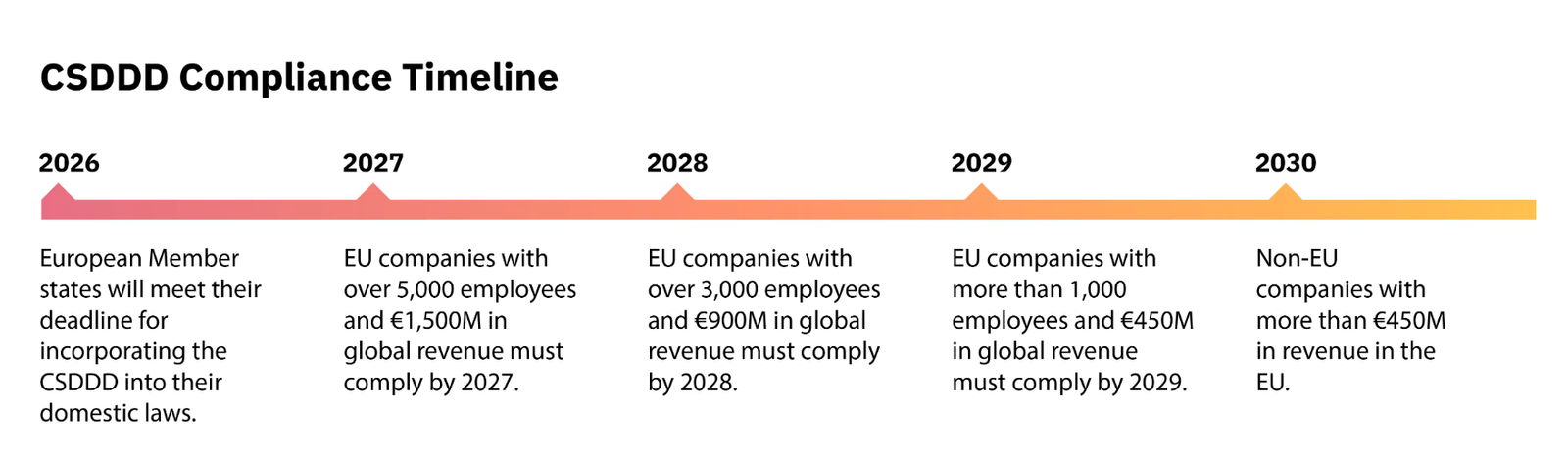
Source: Persifoni (2025), “CSDDD – The EU’s Corporate Sustainability Due Diligence Directive Explained”
Failure to comply with these regulations can have severe consequences. Beyond substantial financial penalties and potential civil liability, companies risk reputational damage that can far outweigh the cost of compliance. In today’s market, consumers increasingly demand accountability and ethical practices from the brands they support, making the moral compass of a company a critical factor in purchasing decisions. Companies that fail to align with these expectations risk being “called out” publicly, which can lead to loss of trust, reduced market share, and long-term harm to their brand value (Forbes Nonprofit Council, 2024).
What role can non-profits working in the social sector play in the CSDD?
The ‘Social’ component of the EU’s Corporate Social Responsibility (CSR) regulations is particularly relevant to the work of non-profit organisations, especially when it comes to securing funding through corporate partnerships. This pillar focuses on promoting equitable, inclusive, and humane practices within corporate operations, including areas like community investment and philanthropic activities and human rights policies and practices.
Open Cultural Center’s (OCC) is a non-profit that works towards building bridges between communities by promoting the social and labour inclusion of migrants and refugees. This is achieved through training, socio-educational activities, support networks, and fostering a culture of diversity and innovation. The organization aspires to be a reference in developing pioneering solutions for the inclusion of migrants and refugees at various stages of their journey.
For charities like OCC, which work directly with displaced populations, the mission is inherently tied to the ‘Social’ pillar. By promoting refugee inclusion through education and cultural initiatives, OCC addresses critical human rights issues—key areas that the CSDDD requires companies to monitor within their operations and supply chains. It is also essential to acknowledge that refugee displacement intersects with the ‘Environmental’ and ‘Governance’ pillars. Environmental degradation and climate change are increasingly significant drivers of forced migration, while robust governance is crucial to ensure the fair treatment, protection, and inclusion of refugees. While these pillars are interconnected, OCC is uniquely positioned to support companies in fulfilling their obligations under the Social pillar, offering valuable expertise and partnership opportunities to advance meaningful social impact.
Insights from experts & stakeholders in Sustainability and business development
To explore how we can position ourselves further, I interviewed Carles and Anna from Worsley Consulting. Carles, Sustainability and Business Development Director, outlined that whilst it is certainly new terrain for the CSRDD, refugee-focused NGOs bring a unique value proposition to companies striving for CSRD compliance. Such partnerships can enable companies to demonstrate tangible progress in addressing social equity and inclusion, key components of the social pillar. They can also expand perspectives, through introducing companies to diverse realities and promote inclusivity within their corporate culture, aligning with broader ESG objectives. In the current geopolitical climate, the relevance of social impact organizations is heightened, offering practical solutions to achieve SDG objectives while addressing urgent humanitarian needs.
Carles spoke of some of the challenges too, outlining that despite the growing awareness of CSRD, many companies are postponing compliance preparation. This procrastination is exacerbated in regions like Catalunya, where regulatory transposition and guidance have been delayed by the Spanish Congress.

To accelerate compliance, NGOs and charities can step in to assist by providing targeted training and resources tailored to SMEs and smaller organizations.
Sustainability and Business Development Director
WORSLEY Acceleration Services
Anna, Sustainability Director at Worlsey, noted that companies tend to focus more on environmental over social goals. While the directive defines environmental aspects relatively well and existing frameworks support them, the social aspects — such as human rights and labour conditions — receive far less regulation. This ambiguity may push companies to deprioritize social goals and focus instead on meeting environmental requirements. Some might argue that, as a result, organizations risk resorting to superficial measures to tick CSRD compliance boxes. In the worst cases, this could lead to greenwashing or ‘social responsibility washing,’ where companies meet the bare minimum requirements of the CSDDD while staying disconnected from the real social issues affecting communities.
To prevent this, it is essential for businesses to go beyond surface-level compliance and focus on building and maintaining strong, sustainable relationships with the social sector. Genuine collaboration with NGOs and community organizations ensures that corporate efforts are rooted in meaningful action, fostering long-term impact rather than symbolic gestures.
Challenges and opportunities of the CSDDD for the companies
Whilst the environmental pillar may overshadow the social pillar due to the presence of more established practices and frameworks, the social pillar presents a unique opportunity for organizations like Open Cultural Center (OCC). The CSDDD provides NGOs like OCC with a valuable chance to position themselves as indispensable partners for companies striving to meet these new regulations. By aligning their missions with CSDDD objectives, NGOs can attract funding, broaden their impact, and foster meaningful collaborations across both the private and public sectors.
This interconnectedness underscores the importance of adopting a holistic approach to ESG compliance. Companies have the opportunity to partner with organizations like OCC to tackle social challenges while addressing the broader, systemic issues of environmental sustainability and governance that contribute to displacement.
Supporting refugee-focused charities is not only relevant to meeting the social criteria of CSR but also reinforces a company’s role in addressing root causes and consequences of global crises.
Another potential challenge for companies aiming to partner with refugee support organizations to meet the social requirements of the CSRDD is the perception that such partnerships are “too political”. The global discourse surrounding refugees often intersects with sensitive political issues such as migration policies, border control and national security.
For some companies, this perceived political complexity may deter engagement, as they fear alienating stakeholders or becoming embroiled in controversy. Refugees exist as a consequence of a number of reasons, including but not limited to global inequalities, the devastating impacts of war (often initiated and exacerbated by the Western world), and the accelerating challenges of climate change. These issues demand collective action from all sectors, including corporations.
Where do we go from here? A path to meaningful social impact through the CSDDD
As we navigate the evolving landscape of sustainability and corporate responsibility, it’s essential to reflect on how we can deepen our involvement and amplify our impact. The pressing question is not just about compliance with the CSDDD but about leveraging our expertise to create lasting social change.
OCC brings unique expertise to the table, offering the knowledge and tools organizations need to meet the social criteria embedded within these frameworks. By sharing this expertise, we can guide and support companies in understanding and addressing pressing social issues whilst helping them meet the criteria of the CSRDDD and subsequently showing partners, customers and competitors what they stand for. The role of OCC, and other non-profits either involved or interested in being involved, is not just about ticking boxes but about inspiring companies to see the potential of transformative, socially-driven initiatives.
Collaboration is key to achieving meaningful impact. For instance, engaging with refugee support organizations offers a pathway to both tackle and educate people on critical global issues while meeting social responsibility criteria. Through this education, we can help people and companies understand the nuances of these issues, engage more deeply with them, and take actionable steps to support solutions. This could include everything from volunteering and funding to strategic collaborations that align with SDG and CSRD objectives.
Ultimately, our greatest achievement could be fostering a culture of shared responsibility—one where companies, NGOs, and individuals unite to address social challenges and thus bridge the gap between knowledge and action. Open Cultural Center aims to soon host online information sessions with experts in the fields and NGO representatives to further discuss the opportunities for change that are emerging from the CSDDD.
As non-profits navigate this evolving regulatory landscape, there is a clear opportunity to collaborate with corporate partners to drive meaningful social impact — and we’d love to explore how we can work together.
We can be the non-profit you need to implement your CSRD plan
Contact us now and we will evaluate our collaboration options. Fill in the form below to connect with our Corporate team!
References
Council of the European Union, 2024. Corporate sustainability due diligence: Council gives its final approval. [online] Available at: https://www.consilium.europa.eu/en/press/press-releases/2024/05/24/corporate-sustainability-due-diligence-council-gives-its-final-approval/ [Accessed 18 Jan. 2025].
Forbes Nonprofit Council. (2024). How the EU is putting an end to the industrial age. Retrieved from https://www.forbes.com/councils/forbesnonprofitcouncil/2024/08/22/how-the-eu-is-putting-an-end-to-the-industrial-age/?hss_channel=lcp-11076920
Interview with Carles Agustí i Hernandez- WORSLEY Acceleration Services
Interview with Anna Comas Sabadell- WORSLEY Acceleration Services
Niejahr, James Kettlewell, Galdino-Glaeser, 2024 European Union: The new Corporate Sustainability Due Diligence Directive — what does it mean for companies? – Baker McKenzie InsightPlus
Seneca ESG, 2025. EU’s CSRD set to reshape corporate-nonprofit partnerships by 2025. [online] Available at: https://senecaesg.com/insights/eus-csrd-set-to-reshape-corporate-nonprofit-partnerships-by-2025/ [Accessed 18 Jan. 2025].Watershed. (2024). CSRD: How to prepare.