
REFLECTING ON THE ROLE OF SOCIAL THEATRE with KELLY LUA
An article written by Rebecca Rapparini
Kelly Lua & Open Cultural Center
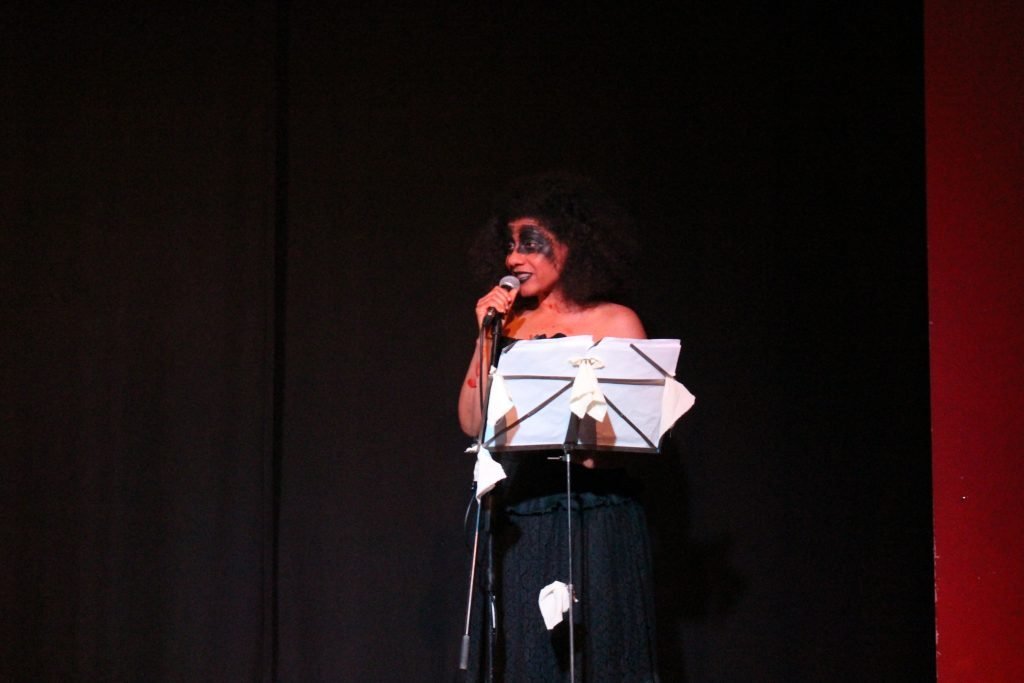
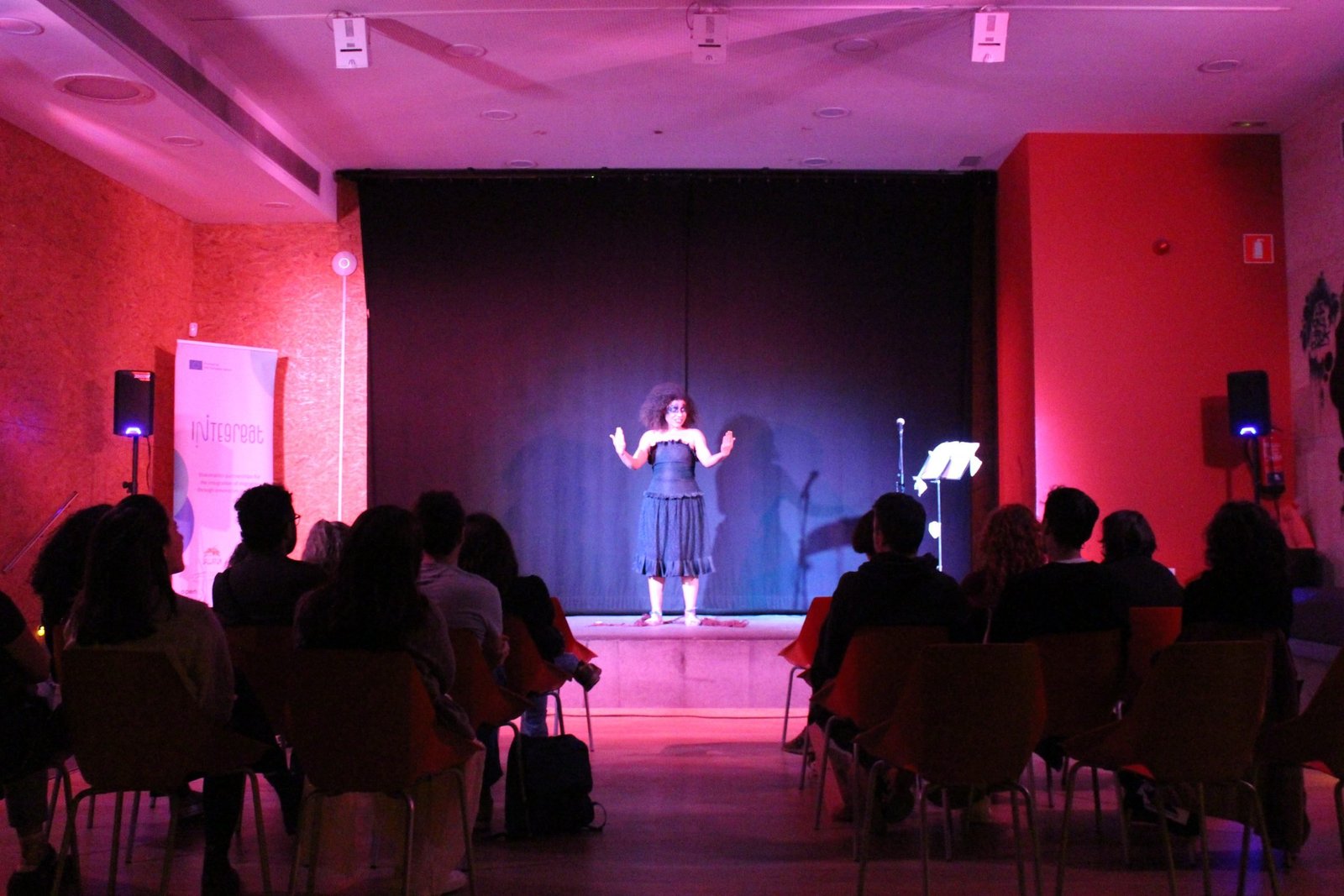
Kelly Lua was first introduced to us at Open Cultural Center Spain in April 2024 during her “Yo Mujer Negra” performance, which was put on by the theater group No Somos Whoppi Goldberg. During her performance, Kelly shared with the audience her experience of being a black woman in a society steeped in prejudice.
Who helped us make this possible
This performance opened a space for dialogue with the audience on crucial issues such as structural racism, identity and Afrofeminism. The event was hosted in collaboration with Espai Jove Palau Alòs and Xarxa BCN Antirumors, and was part of the INTEgreat project, an initiative aimed at improving the integration of migrants and refugees in European cities funded by the European Union through the Asylum, Migration, and Integration Fund (AMIF). You can discover all of the deliverables from this project in the Europe section of our website.
Kelly Lua is an Afro-Brazilian stage actress, director and singer-songwriter based in Barcelona. When I asked if she would be open to an interview about her artistic journey, she agreed without hesitation. Later, in our conversations, I learned how much it can drain her to be approached mainly to share her story as a Black migrant woman in Spain, a story she brought to life in her show, “Yo Mujer Negra”. It is in this performance, a play composed of dramatised poems and songs, that she tells us about her experience of being a black woman in a society full of prejudices, claiming not only her right to exist, but the need to celebrate her existence. Along with that of many others.
“Social theatre is crucial—every kind of social
theatre—because we’re political beings”.
Artistic beginnings
“My voice can no longer remain silent.
I know I am not alone because my cry is universal, my music is an eternal search.”
Kelly Lua’s artistic journey began when she was young, attending a school in São Paulo where art exposure was rare. One day, a teacher organized a play where children would perform television commercials, but she was unable to attend. This missed opportunity inspired her to reinvent herself and ask the teacher to act in a play, but instead of commercials, she created something of her own. This experience became her first expression of her own black awareness.
“I took a doll—all my dolls were white—and it was one of those baby dolls with no hair. Then I put a sock on her head and said I would try a magic shampoo that would make her hair very straight. Here in Brazil they call it ‘fallen hair’ when it is super straight […]. I acted as if I was testing shampoo and lowered myself onto the school desk, put my sock on my head and lifted my hairless doll. This symbolised something that had already happened to me. People had applied products to my hair to straighten it […]. So I did this skit about a shampoo that made your hair so straight that it left you bald. It looked funny, people laughed. […] It was powerful because, at that moment, I was doing theatre without even realising it. Looking back now, I realise that that is where my journey began. I was so young, I was only ten years old.”
Life in the theatre: from Brazil to Barcelona
Following this episode, Kelly Lua began to show a clear interest in theatre. She started practising through free courses in São Paulo, before becoming professional and becoming part of several theatre companies.
As a theatre director, she developed her own methodology that mixes techniques from the Theatre of the Oppressed, the collective creation theatre, community theatre, and everything that comes with her experience as a tireless professional in her field. By staging situations of oppression experienced by marginalised subjectivities, she invites the audience to reflect on the very concept of the ‘margin’, bringing it on stage and questioning it, changing the perspective.
“Today I am a professional, but I have mostly worked more at the margins. […] Even in Brazil I experienced marginalisation. In many places I couldn’t play roles certain roles because people said were not ‘for me’. At first I thought it was because I was not good enough. Then I met other black artists who faced the same barriers. […] I toured Brazil doing street theatre on my own, participating in festivals and training wherever I found opportunities.”
“When I went to Barcelona, I took my shows with me, literally carrying them on the plane. […] Starting over was difficult. As a black woman and a migrant, my art was not understood. I didn’t know where the margins were, the spaces I resonated with. It’s not that I want to stay at the margins; it’s just where I find connection and identity. Unfortunately, the margins are still where society puts us, although in my art we are the ones at the center.”
Yo Mujer Negra
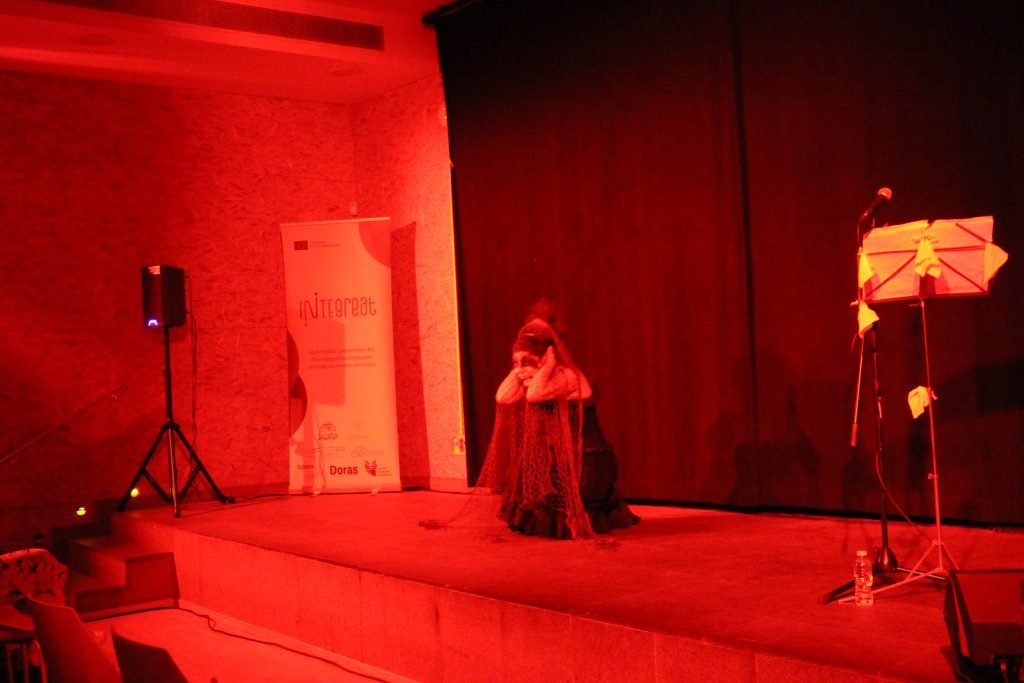
Kelly Lua’s artistic career in Barcelona continued through valuable encounters that led to initiatives of profound social impact. She began to develop “Yo Mujer Negra”, a show that reflects her personal experience as well as broader themes such as black feminism and anti-racism. She is one of the founders of the collective Tinta Negra, a group composed of black actresses, actors and stage creators.
“This is how ‘Yo Mujer Negra’ was born. We had so much to say and, although our voices share a collective experience, they are also very unique because every life, every story, is so different. […]. Our stories are completely different. I am not European, this is a whole other subjectivity […]. So, already from this point, our identities diverge significantly.”
“The first spark was this realisation. I looked at my collaborators and realised: ‘ Wow, there is so much to say’. Honestly, I was tired of being silent, tired of experiencing things in isolation. […] I realised I had a lot to say, and the play started from there. It felt like once I took the first step, everything began to flow. I also always write songs—I compose. So, it transformed from poetry into a play with poetry and music. And it’s something alive because it’s an original creation. It continues to evolve.”
The performance’s capacity to evolve and adapt to changing experiences and themes is crucial for Kelly Lua to be able to dialogue with different audiences in diverse geographical and cultural contexts.
“I have also been able to bring the show to Brazil, which means I have performed it in Portuguese, Catalan and Spanish. Each language brings something different because I have to look for specific expressions and contexts. Racism, unfortunately, is universal, but it manifests itself differently in each place, with distinct phrases and social contexts. This keeps adding new dimensions to the show.
“For me the show is an intake of breath, a space to say: ‘Look, this is our life’. It’s like opening people’s eyes to start creating a certain level of awareness. It is not just empathy – it is impossible to empathise completely because we live these realities on our skin – but it is like a cry for help.
When I perform, there are things that seem so obvious but aren’t. I see people reacting like ‘Wow, really?’ And I think ‘This is my daily life’. It’s about stopping the constant justification of the things that happen.”
Kelly Lua highlights how reactions differ even within the same theatre space, namely how black and white people react differently: on the one hand there is a process of identification, anger, frustration, empathy; on the other feelings of shame, embarrassment and (in the best of cases) questioning. She notices with young audiences reactions are more homogenous and closer to outrage and indignation.
Theatre as education : whose responsibility?
Exploring Kelly Lua’s work as an actress as well as an activist, reveals the passion and pride she puts into everything she does. However, she expresses a growing sense of fatigue towards what she perceives as a ‘social duty’ to always deal with committed issues.
“I am more than this. I am more than this show. I want to work in spaces where people don’t seek me out just because I’m black and I have something to say. I want to work as an artist.”
“Before I had this black consciousness, I made art simply for the sake of it, and I miss that freedom to create without always being tied to a message, to simply flow. And I also want to be paid for that. Right now, I am always wanted for what I represent. I want people to recognise me as an artist and not just for my activism.”
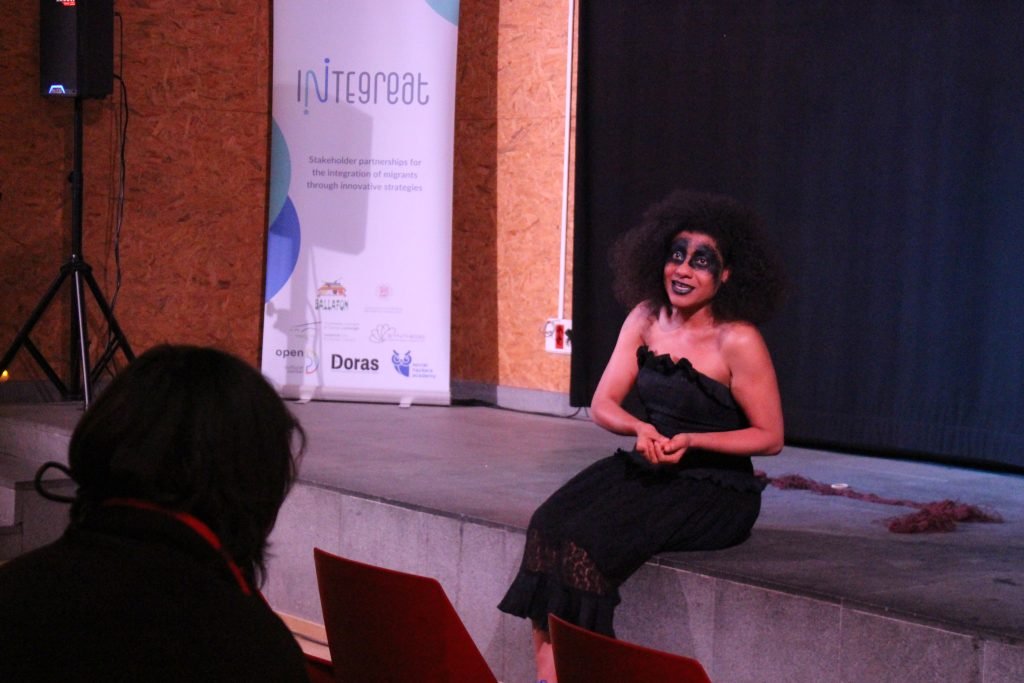
Theatre as a tool for social change has a liberating trait. However, it can be suffocating in a social context where, as a black migrant woman, your art is limited to the margins. It is unfair to expect those who experience discrimination and racism to bear the responsibility of deconstructing the stereotypes attached to them in order to make us reflect on our behaviour and question our responsibilities.
“The thing is… It’s delicate, but I’ll say it: any European person has a European mindset, regardless of their skin colour. Because they grew up there, lived there—so it’s inherent. The question is about the deconstruction one undergoes. […] I think Europe is like a baby—it’s still growing, you know? There’s so much deconstruction needed to understand things.”
In this process, social theatre is certainly a fundamental tool, because of its cathartic effect, its emotional power. At the same time, theatre is a space for challenging racism, sexism, for opposition and protest, for resistance and political fight. As Kelly Lua shows us: social theatre is a space of light and shadow, of continuous balancing, of individual and collective work, of activism and art.
Discover more of Kelly Lua’s work and latest projects by following her on social media:
This article was published as part of Integreat, a project funded by the European Union.